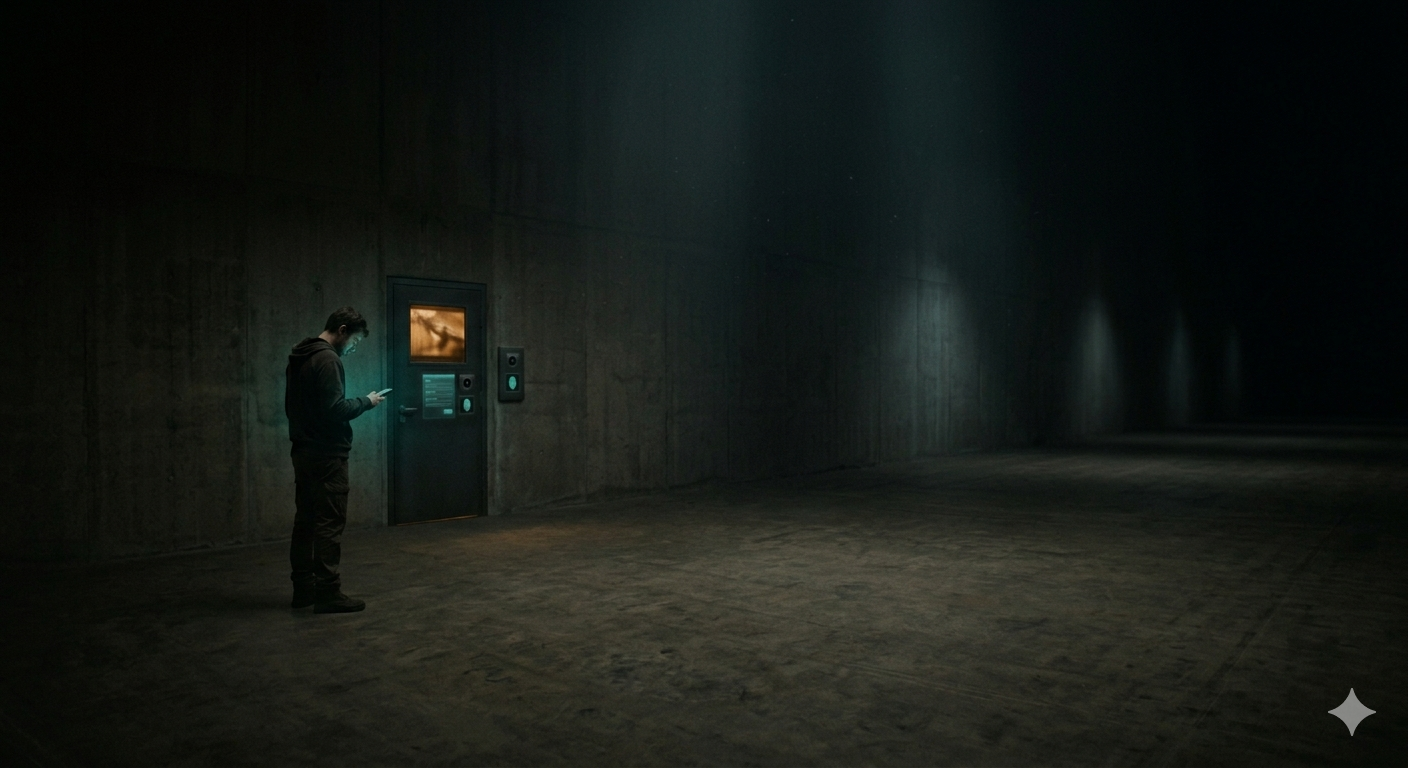
The question did not come first. The work came first.
SatsRail began as a payment rail. A way to settle Bitcoin Lightning invoices without custody, without an account at the rail, without a central party holding anyone’s keys. The scope was small and technical. Handle the money. Do it without becoming the thing you were trying to avoid. Ship.
Somewhere inside that work, a question appeared that was not on the spec. It arrived not as an insight but as an irritation. A small wrongness that would not resolve and would not stay quiet and eventually refused to be filed as a later problem.
Why do I need an account to buy a movie?
I was building the rails for merchants to accept Lightning. The first real proof of concept was going to be digital content (video, audio, written work) because that is where the settlement properties of Lightning shine: instant, global, capable of micro-amounts, with no chargebacks and no card networks. For a creator selling a five-dollar rental to a stranger across the world, the technology was already better than anything the incumbents had. The money part was solved.
So I sat down to build the checkout. And the checkout asked: where does the account go?
Where does the login live? Where does the customer profile sit? Which table in which database records who watched what and when? Every e-commerce framework, every content platform template, every reference implementation in the industry assumes the same starting point (a user table) and builds outward from it. The account is the load-bearing beam. The product is the finish.
And then the question. Why does a stranger who wants to watch a film need to hand over an email, a phone number, a password, a saved card, a billing address, a device fingerprint, a purchase history, and, increasingly, a piece of government ID, before they can press play?
None of that is the movie. The movie is a file. A few gigabytes of encoded pixels. The transaction is simple: you have the file, I want to watch it, here is the price. Everything else is the system talking about itself.
I did not intend to ask this question. I was building a payment rail. The question showed up in the way real questions show up. As a thing I could not engineer around without first admitting it was there.
What the Account Actually Is
The account is built to look like an access contract. It behaves like something else, dressed in that language.
Look at what the account actually does. It does not deliver the movie; the CDN does. It does not verify the payment; the processor does. It does not protect the creator; encryption does. What the account does that nothing else does is persist a relationship between you and the platform. A relationship that survives the transaction, that was never necessary for the transaction, and that accumulates value for someone other than you with every use.
The industry calls this “the user journey.” The “customer lifecycle.” The “CRM relationship.” The vocabulary is warm. The structure is extractive. You paid for the movie. You continue paying, in data, in attention, in attack surface, for as long as the account exists. The framing inverts what is happening: the movie was the purchase you came for, the account was a small administrative step to unlock the experience. Run it the other way. The movie is the bait. The account is the catch.
Every argument for why the account has to exist turns out to be an argument for why it exists for someone else. Fraud prevention protects the platform, not you. Personalization trains the recommender, not you. Customer service gives them a record to reference, not a record you control. Legal compliance binds you to obligations you did not read. The account does not extend your rights. It extends their reach.
Why the Question Lands Now
A naive question only lands when the ground is ready for it. The ground has shifted. Two technologies are fusing into an architecture most people have not yet fully imagined but sense coming: inferential AI on top of programmable money. The account is the interface layer of that architecture: not the threat in itself, but the handle that makes the rest reachable. The five-dollar rental is the smallest, cleanest place to see the shape. If you cannot buy a movie without an account, you cannot do anything without one. And if everything runs through an account, everything runs through whoever can reach the account.
Answering the Question Honestly
Once the question was in the room, the second question followed: could I build the movie transaction with the account actually removed, rather than reformed, softened, or muted by a “privacy mode” that still resolves to an account underneath? A stranger pays for a movie, watches it, the access expires when it should, and no persistent identity is left behind (no row in any database connecting “person” to “title” to “timestamp”), while the creator is still protected and the money still settles.
The answer turned out to be yes. Each piece already existed. None of them had been assembled in this order before.
What emerged on the other side of the naive question was an architecture: a way of arranging the pieces so that the answer to “why do I need an account to buy a movie?” becomes you don’t, and every reason you were told you did was someone else’s interest speaking through you. The architecture removes the handle. There is no longer anything persistent for the system to pick up, because the transaction is the relationship. When the movie ends, the relationship ends, and the next time the viewer comes back, they are a stranger again, by design. Payment as Credential walks through how it works.
The claim has a boundary, and it is worth drawing here rather than discovering later. Some services genuinely require what the account collects. A refund needs a way to find the payment. A subscription needs continuity between visits. A parental control needs to know which viewer is the child. Recovery needs something that survives a lost device. Where the service is the relationship, the account is doing honest work, and nothing that follows pretends otherwise. The argument is about the movie, the article, the song. Consumption. Where the relationship ends at the transaction, the account is a choice rather than a requirement, and the choice was never the viewer’s.
The question is naive only in the sense of refusing a premise that everyone else accepts on its own terms. Once the premise is refused, the engineering is not hard. It is in fact simpler than the architecture that insisted the account had to be there.
The account was not a requirement. It was an assumption. Every company that grew up inside the assumption ended up with a business model that depended on it, and that is why the assumption is defended so vigorously. The naive question threatens a revenue, not a capability. The capability to deliver a movie to a stranger without an account was always there. Nothing was stopping it except the industry that had built itself on the opposite.
The Shape of the Capture
The movie is not the only place the account is lying about what it is for. The same structure holds everywhere. Every time an ordinary exchange is routed through a persistent account, ask who the account is really for. A loaf of bread paid for by tapping a card tied to your identity produces a record of where you were, when, and what you ate. A record that did not need to exist for the bread to be sold. A conversation with a language model routed through a login produces a record of what you were thinking about, a record that did not need to exist for the question to be answered. A bus ride on a registered transit card produces a record of your movement, a record that did not need to exist for the fare to be paid.
In each case, the transaction is the pretext. The record is the product.
And in each case, the people who operate the account will produce a fluent explanation for why it has to be this way. Fraud. Safety. Compliance. Personalization. The vocabulary rotates depending on the industry. The function does not. The function is to maintain the handle. To ensure that every ordinary exchange leaves behind a thread the institution can pull on later. Nothing that moves through money is supposed to leave no trace.
The shape of the capture is always the same. A useful thing emerges. Commerce, communication, transit, entertainment. A bottleneck forms around it, usually for a plausible reason. Over time the bottleneck is renamed an infrastructure and the infrastructure is renamed a necessity. At the bottom of every necessity is an account. At the top of every account is someone who is not you.
This is not a new observation. What is new is that, for the first time, there is a substrate underneath all of this on which the account becomes optional. A payment can settle without a card. An access can be granted without a login. A conversation can persist without a profile. A commitment can be recorded without an authority. The tools now exist. The only question is whether we assemble them, or whether we let the industries that grew up inside the old architecture keep explaining to us why the handle has to stay attached.