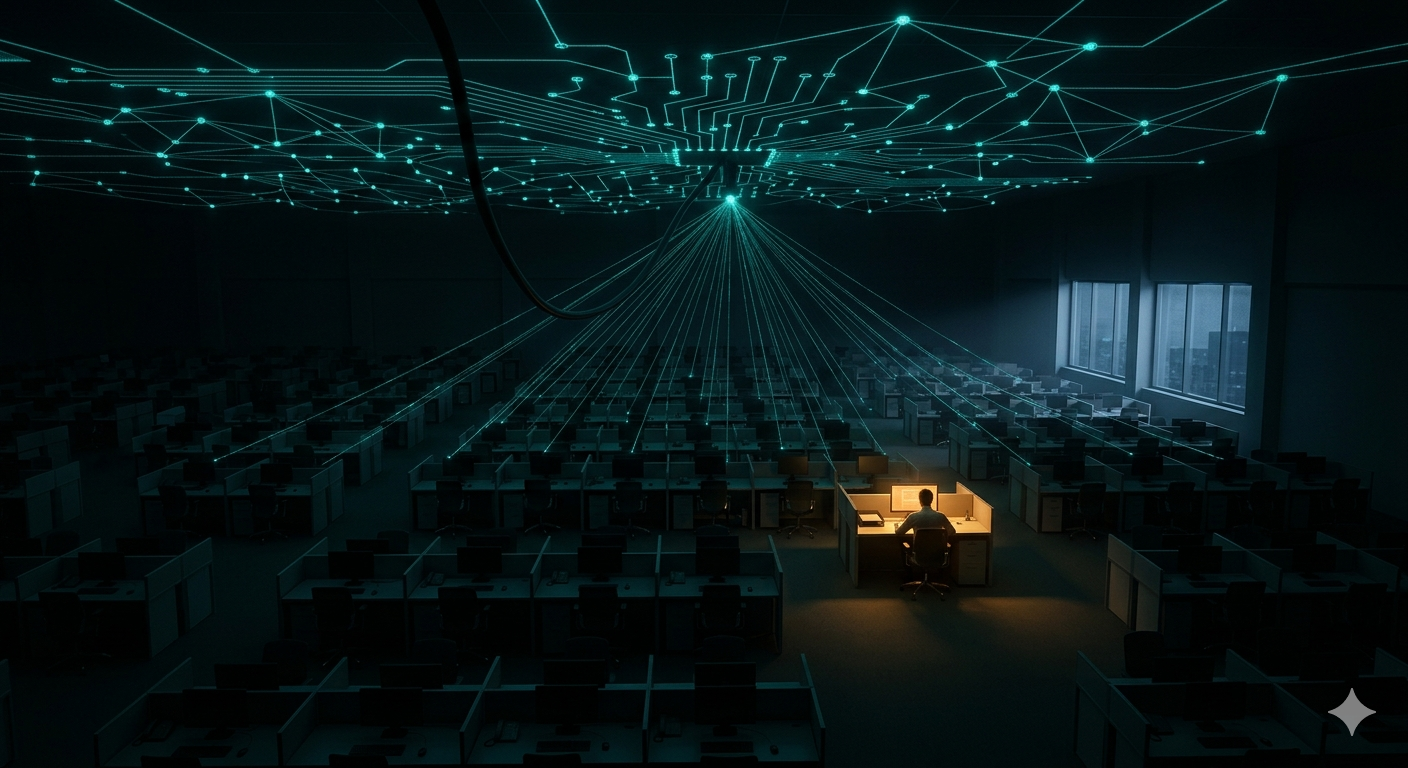
The Net interprets censorship as damage and routes around it.
John Gilmore, 1993
There is no warning shot. No hearing. No appeal. A card network decides that an entire legal industry is too risky, and a phone call goes out. The call does not go to the businesses that will be destroyed by it. It goes to the processors. The processors comply, because they have no choice. And the companies at the bottom, the ones that built teams, hired people, served customers, followed every rule, find out when the revenue stops.
It happened to an industry I worked in, and it is still happening, across sectors, to businesses that have broken no law.
The Anatomy of a Shutdown
The structure is always the same. Three layers, one direction. Understanding it matters because the people who experience the damage are never the people who made the decision.
Layer one: the card network. Two entities control the rails on which nearly all non-cash commerce in the developed world runs. They set the rules. Not laws but internal policies, updated at their discretion, enforced through contractual leverage over every bank and processor in their network. When a card network decides an industry is too risky, it does not need a court order. It needs a memo.
Layer two: the processor. Payment processors, the companies that connect merchants to the card networks, receive the directive. They have a choice that is not a choice. Comply, or lose access to the network that makes their entire business model possible. No processor is going to sacrifice that relationship to defend a cannabis dispensary in Colorado. The math does not work. So they comply. Immediately.
Layer three: the businesses. The companies that actually serve customers. The ones that built point-of-sale systems, hired compliance officers, trained staff, signed leases. They find out last. Sometimes the processor calls. Sometimes the transactions start failing. The revenue disappears before the explanation arrives.
That is the anatomy, and the system worked exactly as designed: a policy decision at the top, contractual compliance in the middle, economic destruction at the bottom. No law was broken at any layer, no court was involved, and no due process was offered.
What It Looks Like from the Bottom
I spent years in the payments industry before I started building SatsRail, not as an observer but inside it. Building payment solutions, serving merchants, navigating the compliance landscape that the card networks impose on everyone downstream.
One day the call came. A major card network decided that the debit payment solution being used in a legal but politically awkward vertical was no longer acceptable. The directive trickled down to the processors. The processors complied. And the company I worked for absorbed the impact: a payments business with good lawyers, experienced compliance people, and a deep understanding of the regulatory environment.
In the months that followed, a large share of the workforce was let go.
The company had done nothing wrong, no regulator had taken action, and no customer had been harmed. A card network made a policy decision, and the companies at the bottom of the chain had no mechanism to push back, no alternative rail to switch to, and no time to adapt.
Years later, the company had still not fully recovered. Eventually it had to outsource its payment processing entirely to another provider, because dealing with the card networks directly had become untenable. The business survived by retreating from the rails it had been built on.
A company that had spent years navigating exactly this kind of regulatory terrain could not make payments work. Not because the product was illegal or the regulations unclear, but because the infrastructure itself was controlled by entities that could unilaterally decide which legal industries deserved to participate in the economy.
The Pattern Is Everywhere
Cannabis is one case. It is not unique.
The card networks cite legitimate concerns: federal law conflicts, money laundering risk, reputational exposure. Whatever one thinks of the justification, the mechanism that follows is the problem. The concern may be reasonable; the unilateral power to act on it, without process, without appeal, without considering the downstream human cost, is not.
In July 2023, a major card network directed processors and banks to stop allowing marijuana purchases on debit cards. The drug is legal in dozens of states, and billions in legal revenue flow through the industry. None of that mattered: the network’s position was that cannabis remains federally illegal and its systems would not facilitate those transactions. The consultants, the compliance teams, and the legal opinions were all irrelevant, because the network said no.
The adult content industry hit the same wall, in a version The Choke Point tells in full: one newspaper column in December 2020, and payment processing for one of the largest platforms in the industry was suspended within days.
Firearms retailers face the same pattern: processors that refuse online transactions, banks that close gun-shop accounts without explanation, and a 2022 merchant category code for firearms that gun-rights groups read as tracking infrastructure built and waiting. Before any of these there was Operation Choke Point, the 2013 initiative that pressured banks into cutting off legal businesses the government called “high risk”. The Receipts lays out that record in full; what matters here is that it proved the playbook works.
In March 2026, the FTC sent warning letters to the CEOs of the four largest payment networks and processors over debanking practices. That the federal government is now investigating the very entities that control the payment rails measures how far the problem has gone, and how fragile any system is where two or three private companies decide who gets to participate in commerce.
The instinct, when you hear these stories, is to fight it. Hire the best counsel, file a lawsuit, lobby for better regulations. That instinct is not wrong. It is insufficient.
This is the structural problem that legal and political strategies cannot fully address. Even if you win a policy battle today, even if a new administration reverses a restriction or a court rules in your favor, you are still building your business on rails controlled by entities that can change the rules tomorrow. The dependency is the vulnerability. As long as your revenue flows through someone else’s permission, you are one phone call away from losing it. The FTC letters are a good sign and executive orders against debanking are a good sign, but signs are not infrastructure: the rails are still private, the chokepoints are still in place, and the next administration, or the next crisis, or the next newspaper column, can reverse whatever protections exist today.
The Architecture That Cannot Make That Call
Bitcoin on the Lightning Network settles a payment in under a second between two parties, with no intermediary who can reverse it and none who learns who paid whom. The nodes that route it see a hop, not a customer. There is no card network to make the phone call, no processor to comply with a directive, no layer between the buyer and the seller that can decide whether the transaction is acceptable.
This is an architectural fact, not a philosophical position. A Lightning payment is a cryptographic handshake between two nodes. The payment either succeeds or it does not. No third party approves it. No compliance team reviews it. No card network blesses it.
For the cannabis dispensary in Colorado, legal under state law and paying taxes, a Lightning terminal makes the policy decision at card-network headquarters irrelevant, because the payment never touches their network. For the firearms retailer who has watched banks close accounts and processors refuse service, Lightning is an alternative rail no bank can shut off, for the simplest of reasons: the bank is not involved. For the adult content creator whose income disappeared when a card network answered a newspaper column, the payment and the content become separate concerns, as they should be.
I started building SatsRail because this infrastructure needed to exist: a non-custodial rail that connects merchants to the Lightning Network without ever touching the funds. The merchant runs their own node or connects their own wallet. There is no card network in the loop, no processor who can be pressured, no phone call that can shut it down.
The Next Call Is Already Coming
If you run a business in an industry that a card network has not yet decided to restrict, you might read this and think it does not apply to you. Consider that the cannabis companies thought the same before 2023, the adult platforms before 2020, the payday lenders and coin dealers before Operation Choke Point.
The list of industries that are “too risky” only grows; it never shrinks. Each new restriction establishes a precedent that makes the next one easier, and the moral story changes to fit: child safety, money laundering, federal law, reputational risk. The mechanism underneath is always the same. A private entity with control over critical infrastructure decides who gets to use it.
The call is always coming. The only variable is whether it matters when it arrives. A payments company with good lawyers and experienced people lost a large share of its employees because a card network made a phone call.