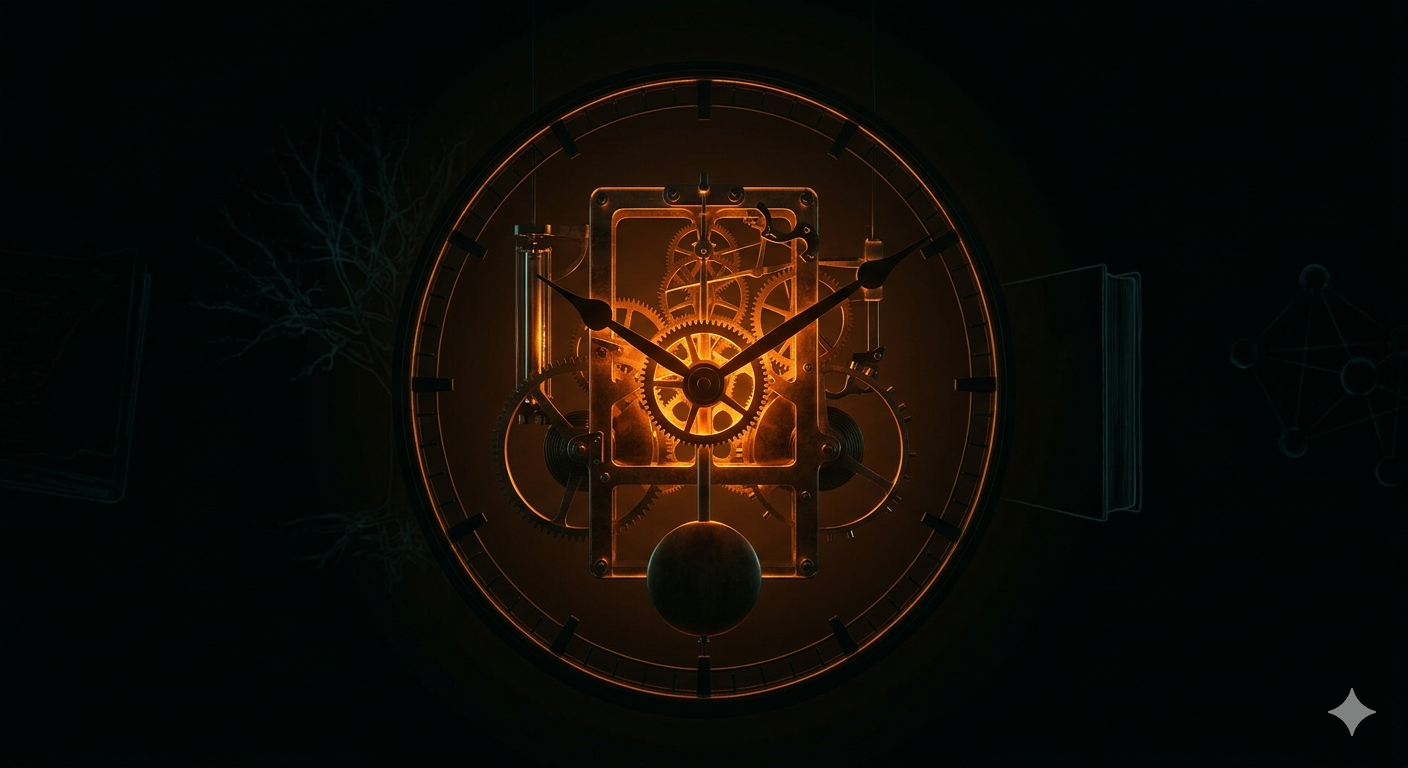
A clock to set the present against. A sketch for the engineer who picks it up. A note on how the book was made.
Epilogue: The Clock
Time is the substance I am made of. Time is a river which sweeps me along, but I am the river; it is a tiger which destroys me, but I am the tiger; it is a fire which consumes me, but I am the fire.
Jorge Luis Borges, “A New Refutation of Time”, 1947
Gigi called Bitcoin a clock. The longer I sit with it, the more right he seems.
Not a ledger. Not money. Not a nervous system. Not even a tree. A clock. The one clock I have not found a way to reset. Every block is a tick that required real energy to produce, and the sequence is irreversible. You cannot move the hands backward because the energy is already gone. You cannot skip ahead because the energy has not been spent yet. This is not a design choice. It is thermodynamics. The ticks already happened. The entropy already increased. The arrow points one way.
Every other record humanity has built (legal archives, institutional memory, scientific journals, reputational histories) can be rewritten by whoever controls the system. The clock cannot. No policy protects it and no institution guards it; the energy that produced each tick has already dissipated into the universe. You would need to reverse entropy itself. Physics does not offer that option.
There is a question worth naming directly, because the rest of the chapter rests on the answer. Every signal can now be manufactured at near-zero cost: video that shows you saying what you never said, audio in your voice reading a script you never wrote, documents bearing your signature on commitments you never made, news events that never occurred, witnesses who do not exist. In that world, how does anyone, human or machine, tell what is real?
This is not a hypothetical. The tools are here. A convincing deepfake costs cents. A thousand convincing deepfakes cost a little more. A million is trivial. The cost of producing any particular signal has collapsed toward zero, which means the information value of any particular signal has collapsed with it. The photograph was once a witness because producing it required cost: equipment, presence, time. The signed document was a commitment because producing it required a hand. Both of those chains of evidence have now been severed. The form no longer carries the weight it used to imply, because the form can be rendered by anyone, on anything, for nothing.
What this dissolves is everything built on reputation: credentials, institutions, platforms, brands, reviewers, peer-review systems, citation networks, the architecture of trust by association. Each of them required a scarcity of identity that the tools have now eliminated. A reviewer can be impersonated. A brand can be cloned. An institution’s voice can be reproduced. A peer can be fabricated. The trust that took decades to accumulate can be drained in an afternoon by anyone with a model and a script. The defenders of these systems are not wrong to be alarmed. The thing they are defending is being undermined at its base.
What survives is the signal that could not have been produced cheaply, not because it is more truthful than the others but because it cannot be faked. A deepfake of me saying something costs pennies and is indistinguishable from real. An inscription on a specific block at a specific moment, anchored by specific hash power, costs actual sats and cannot be retroactively generated at any price. You can forge the video. You cannot forge the block. The block exists because the energy was actually spent, somewhere in the physical world, by miners whose machines ran, and no amount of rendering inside any subsequent simulation can change that fact.
In a world where every rendered surface can be forged, the one thing that cannot be rendered is the energy that was actually burned. The render can fake the news, the voice, the face, the document. It cannot fake the hash power on a block. It cannot fake the sats that were actually sent. It cannot fake the moment those sats were sent, because the moment is the block and the block is the energy and the energy is the physical fact no render gets to edit. The clock is the hard edge in the render. The place inside the system where the system stops being able to make things up.
This is why sequence is foundational to knowledge and not merely useful to it. I am not drawing that from first philosophy. It is a structural consequence of the specific world we now live in, in which every other kind of evidence has become cheap, and the only expensive evidence left is the evidence written into a substrate physics refuses to reverse. When the render is perfect, the only remaining ground is the thing that is not rendered. Every epistemic primitive humans have ever relied on (testimony, credential, document, photograph, recording, citation, institutional record) was defensible in a world where producing fake versions of them was expensive. That world is ending. The clock is the primitive that remains when the others dissolve.
And a clock, I have come to think, is close to the first thing any intelligence needs if it is going to reason honestly about reality. Without a shared, unforgeable reference for what happened before what, I do not see how cause is reliably distinguished from effect. How history is separated from fabrication. How a signal that came first is told apart from one inserted after the fact. Sequence is the foundation everything else (trust, weight, knowledge, truth) seems to rest on.
Reading back over what Satoshi built, the frame that keeps surviving for me is this: he built a clock. Everything else (money, contracts, inscriptions, the nervous system, the tree) can grow around a clock that no one can stop and no one can rewind. The frame has to earn itself against the architecture, not against my certainty about it.
Here is the hope, held at the level I can defend.
The fear has always been: what happens when the machines are smarter than us? Every apocalyptic scenario (Skynet, paperclip maximizers, misaligned superintelligence) shares the same structural assumption: that a sufficiently powerful system, unconstrained by human oversight, will optimize for something humans did not intend, and no mechanism will exist to stop it.
The proposed solutions all follow the same pattern. Alignment research. Kill switches. Oversight boards. Constitutional AI. Each one is a leash: an attempt to constrain the machine from outside, maintained by humans who are slower, less capable, and eventually less relevant than the thing they are trying to control. And every leash has a holder, and every holder is a chokepoint. The ratchet turns.
The tree offers something different: a compass instead of a leash.
A superintelligent system that can rewrite any database, manipulate any reputation network, generate any argument, and outthink any human committee still cannot, as far as I can see, do one thing: go back in time and fake the energy that was burned in block 400,000. Or block 900,000. Or block 2,000,000. The thermodynamic record is not protected by human vigilance. It is protected by physics. The energy was spent, and no intelligence, no matter how vast, can edit what already dissipated into the universe.
A tree of the kind the earlier chapters have tried to describe, grown around the clock, weighted by cost and time, structured by proximity, validated by hashes, tagged by the identities that signed into it, could give any intelligence a reference point that no other intelligence controls: no human, no corporation, no government, no other machine. The thermodynamic substrate simply exists, the way gravity exists, the way the speed of light exists. Whether a structure of that kind, at any realized scale, can function as ground truth for a machine trying to reason its way out of a curated training set is the question I have been circling. You can build on the substrate. You can read it. You cannot edit it. That much I can defend. The rest is where the argument is being made.
If the answer to that question turns out to be yes, a machine that can read the tree always has access to what conscious beings collectively valued enough to anchor at real cost over real time: not what an institution declared true or a training set implied, but what someone, somewhere, burned irreversible energy to commit to. That accumulated record (the weight of every signal, the honesty of every silence, the scar of every fallen branch) is a compass that would point toward what mattered. Not what was popular or profitable. What was worth the cost.
On that reading, the tree does not constrain the machine. It grounds it. The difference matters to me. A leash says you cannot go there; a compass says here is where you are relative to where everything has been. And where the leash requires a holder, the compass requires only the clock.
This book began with a phone call. A card network made a decision, a directive trickled down, and a company lost a large share of its people in an afternoon. No law had been broken. The architecture had a chokepoint, and the chokepoint was used.
The rabbit hole led, in my experience, from payments to morality to identity to memory to the oracle problem to the nervous system to the tree to the clock. Each step deeper revealed, for me, the same pattern: centralized infrastructure is governance architecture, and every bottleneck becomes a point of capture.
The answer I kept arriving at was the same. Do not reform the gatekeeper. Remove the gate.
Satoshi removed the gate from money. A tree of the kind I have tried to describe might do the same for truth, and the clock beneath both, if I am seeing it right, does it for time itself. I offer the sequence as a contribution to a conversation, not as its last word: whether the later two land is for readers, builders, and time to decide, and the first has already been decided by the network that has been running for seventeen years. If the machines do become smarter than us, if money becomes a memory and labor an artifact and humanity moves to whatever comes next, the clock will still be ticking, block by block, tick by tick, an unforgeable record of what mattered enough to burn energy for, stretching back to the genesis block and forward into whatever world machines and humans end up building together.
The phone call is always coming. The only variable is whether it matters when it arrives.
The clock keeps ticking either way.
It was never about the money.