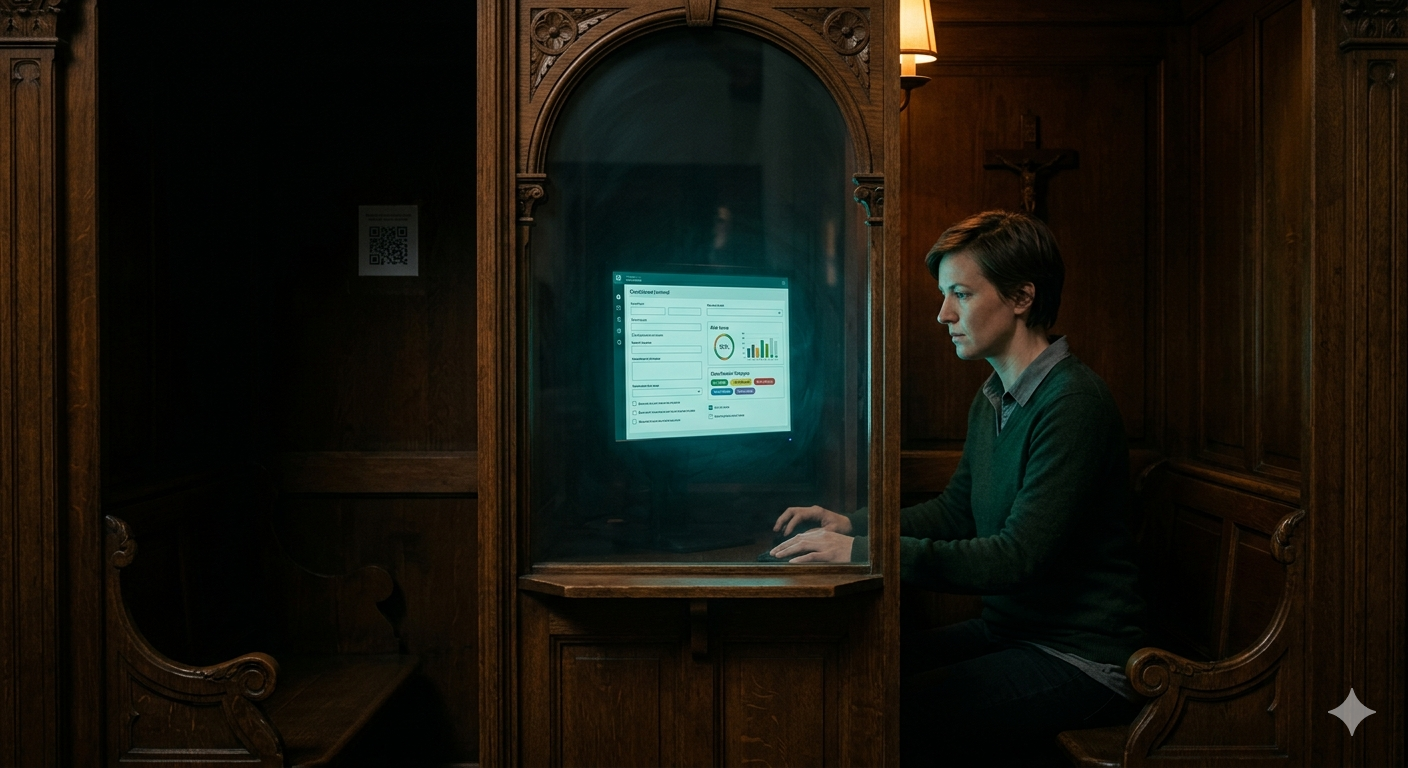
The barbarians are not waiting beyond the frontiers; they have already been governing us for quite some time. And it is our lack of consciousness of this that constitutes part of our predicament.
Alasdair MacIntyre, After Virtue, 1981
I noticed the pattern in April 2026, when the European Commission announced that its age-verification app was ready. Ursula von der Leyen, the Commission’s president, presented it as the next step for safer online services and compared it to COVID passports. One scan would gate access to digital services across the bloc.1 The language was calm. Safety. Verification. Protection. It was the same register as a public-health announcement. It was not asking anyone to accept new power. It was announcing that the power was already there, and that decent people would of course assent to it.
Around the same time, British officers were detaining people across the UK for offensive comments on social media. The rate was roughly thirty arrests a day under section 127 of the Communications Act and section 1 of the Malicious Communications Act.2 The framing in each case was familiar: a speech law had been violated; the officers were enforcing it; the system was working as designed. The language around the law was calm. Public safety. Protection from harmful speech. Different country, different mechanism, same register.
Once I saw it in one announcement, I saw it in others. Control rarely arrives wearing its own name; it arrives as protection, as responsibility, as the only reasonable thing a decent society would do. It wears the language of virtue so naturally that questioning it feels like questioning goodness itself. That is the mechanism.
The pattern is older than any living institution. But the version running now is different in ways that matter.
The Old Architecture
For most of Western history, the moral framework that justified social control was religious. The church provided the vocabulary of right and wrong, the mechanisms of accountability (confession, penance, judgment), and the metaphysical grounding that made the whole system feel inevitable rather than constructed. The observation is structural, not anti-religious. When a single institution holds the authority to define sin, it holds the authority to define the boundaries of acceptable thought, and obedience, once moralized, stops looking like control. It looks like virtue. The medieval church framed its authority not as power but as care for your soul: the inquisitor was saving you, not controlling you. The moral story made the control architecture invisible to the people living inside it.
Over the last century religion stepped back from the center of public life in most Western democracies. Secularism won, in the sense that the old moral authority lost its grip. But the need it served did not disappear. Humans are social animals with a deep appetite for moral frameworks: we want to know what the rules are, who the good people are, and what vocabulary to judge by. When religion receded it left a vacuum, not of belief but of moral authority. The seat was empty, and the seat does not stay empty for long.
The New Priests
The state and the technology platforms filled the seat, not overnight and not by conspiracy. They filled it because they were there, because they had reach, and because they had something the church never had: data.
The roles map cleanly onto the older ones. A compliance officer is doing the work a confessor used to do: receiving disclosure, sorting it against rules, recording it. A risk score performs the moral judgment a sermon used to perform, and a content moderation policy plays the role of catechism. Deplatforming, the quiet removal of your ability to speak, transact, or participate, carries the social consequence excommunication used to carry. It just does not require an appeal.
The language changed. The structure did not. But where the old system was at least explicit about being a system of belief, the new one presents itself as neutral infrastructure: managing risk, ensuring safety, protecting the vulnerable. These claims are presented not as articles of faith but as facts, and that makes them harder to question, not easier. Foucault called this arrangement a regime of truth: the discourses a society treats as true, the instruments that sort truth from error, the people authorized to speak. The current regime keeps its apparatus in infrastructure, and its authorized speakers are the compliance systems that run it.
The Ratchet
The mechanism is a loop. A control measure is introduced under a moral justification chosen to be nearly impossible to argue against in public: safety, child protection, national security, financial integrity. Nobody wants to be the person who argued against protecting children. The framing makes society willing to accept less privacy, which creates more data, which creates more surface area for observation, which creates more capacity for control, not just of the original threat but of anything the system can see. And then the expanded apparatus generates new moral justifications for its own existence: now that we have this data, look at what we can prevent. The tool creates the moral argument for the tool. Each turn feels reasonable in isolation. In aggregate, the ratchet only turns one way.
The examples are not theoretical. The push for encryption backdoors runs on child safety, the most unassailable justification available, because no one who argues for end-to-end encryption wants to be positioned as indifferent to the exploitation of children. But a door does not know who is walking through it. A backdoor built for one purpose is a backdoor available for all purposes. The technical reality does not matter to the framing. The moral story does.
Financial surveillance runs on KYC and AML: the story is preventing money laundering and terrorism financing, and the effect is that every person who wants to participate in the financial system must first prove their identity to an intermediary who records every transaction, indefinitely. A merchant opens a business account and hands over identity documents, proof of address, expected transaction volumes, and monitoring of every payment received. If the merchant sells legal goods to willing buyers and breaks no law, the surveillance continues anyway. The system does not watch you because you are suspected of something. It watches you so it can suspect you of something later. In the United States, fewer than one percent of Suspicious Activity Reports lead to any law enforcement action. The system watches everyone to occasionally catch someone, and that ratio does not get discussed.
The Language Is Load-Bearing
The EU said safety. So has every announcement of new digital control architecture in the past decade: safety, compliance, responsibility, transparency. The words are not chosen to describe. They are chosen to preempt objection.
Safety does not mean the absence of danger. It means the presence of monitoring. When a platform says it is making the community safer, it means it has expanded its capacity to observe, classify, and remove. Safety is the word that converts surveillance into a gift.
Compliance contains its own argument. To comply is to meet a standard, and the standard is presented as external and objective, like a law of physics. But compliance standards are authored by the same entities that profit from them. The compliance industry does not serve a moral framework so much as constitute one.
Responsibility gets aimed at anyone who builds infrastructure that does not collect data. You are being irresponsible. You are enabling bad actors. The framing assumes the default state of a system is total visibility, so reducing visibility becomes an active choice to enable harm. It reverses the burden: you are not required to justify watching everyone, you are required to justify not watching.
Transparency, aimed at institutions, means accountability; aimed at individuals, it means exposure. Notice who gets asked to be transparent: rarely the entity making the rules, almost always the person subject to them. Transparency, in practice, flows upward from the governed to the governor.
Each word takes a control mechanism and gives it the texture of a value. You are not pushing back against a system. You are pushing back against safety, against responsibility, against transparency. And now you are the problem.
Why This Is Harder to Resist Than Religion
The old moral authority had a specific vulnerability: it was explicitly metaphysical. It required faith, and you could reject the premises. You could decide you did not believe in a god who tracked your sins, and the system lost its claim on you. Millions did exactly that. Secularism was the act of stepping outside the framework.
There is no outside the new framework.
It does not ask you to believe. It asks you to comply. In place of the supernatural it invokes data, risk models, and algorithmic assessments, which carry the authority of objectivity: they feel like facts rather than claims. The priest needed you to accept a cosmology. The compliance system just needs your ID. And the new framework is distributed. There is no pope to challenge, no council to petition; the authority is embedded in terms of service, payment rules, content algorithms, credit models. When control is embedded in infrastructure, resistance looks like inconvenience at best and deviancy at worst. You are not rebelling against a belief system. You are failing to comply with a process, and processes do not have arguments with you. They just exclude you.
Havel described this in 1978 and called it post-totalitarianism: a system whose authority runs not through force but through the moral vocabulary of the people inside it. The greengrocer hangs the slogan in his window and is asked, not to believe it, but to participate in the ritual by which the system borrows his language back from him. The same arrangement arrives now by payment rail rather than by Party.
The Moral Story Writes Itself Now
The speed is what has changed. When a crisis emerges, a shooting, a financial scandal, a public outrage, the moral demand for more control arrives within hours, and the infrastructure to deliver it already exists. The expansion happens before the deliberation, and the deliberation, when it comes at all, faces a system that has already normalized the new boundary. No prior system of moral control operated at this speed. The church took decades to shift doctrine. Legislatures take years. The algorithmic moral framework updates continuously, and each update becomes the new default.
The test is simple: if a moral principle, fully implemented, expands the institution’s authority, it is a control mechanism wearing the language of values.
What Breaks the Loop
If the loop runs on the surrender of privacy in the name of virtue, the circuit breaker is infrastructure that does not require the surrender: privacy as an architectural default rather than a setting you can toggle, systems where the data is not collected in the first place and the ratchet has nothing to turn. This is why the debate about privacy tools is never really about privacy tools. It is about whether the feedback loop has an off switch. Every system that collects data by default will eventually find a moral reason to use it, and the only reliable way to prevent the misuse of data is to not have it. The warrant principle Privacy Is a Precondition for Morality named applies here too: the justification must precede the intrusion, not follow it. The live question stops being whether you trust the people currently holding the keys, and becomes whether you want a system where the keys exist at all.
Picture the loop with nothing to turn. A buyer pays a merchant. The payment settles. No intermediary records the buyer’s identity, and no compliance system assigns a risk score. No moral vocabulary is required, because no judgment is being made. The transaction stays what it is, neither a confession nor an application for permission nor a data point in someone else’s model of who you are. The architecture has not collected what the ratchet would need.
Privacy by default is the engineering decision that keeps the loop from closing.3
-
European Commission announcement of its EU Digital Age Verification App, April 15, 2026; reported in Bloomberg the same day: https://www.bloomberg.com/news/newsletters/2026-04-15/eu-tries-to-rein-in-social-media-giants-with-new-age-verification-app. Commission President Ursula von der Leyen drew an explicit parallel to COVID-era travel passes. The full case, including security researcher Paul Moore’s 48-hour bypass demonstration, is documented in The Receipts. ↩
-
The Times, in April 2025, published freedom-of-information data showing that more than 12,000 people were arrested in the UK in 2023 under section 127 of the Communications Act 2003 and section 1 of the Malicious Communications Act 1988, a rate that had more than doubled since 2017. Big Brother Watch has tracked the trend across UK police forces. ↩
-
Timothy Leary, “Think for Yourself, Question Authority” (1991): in the transition from industrial to post-industrial information society, thinking for yourself stops being a personal pleasure and becomes a duty, precisely because the apparatus that governs an information society runs on its absence. https://www.youtube.com/watch?v=mfqRPfhxUdc ↩