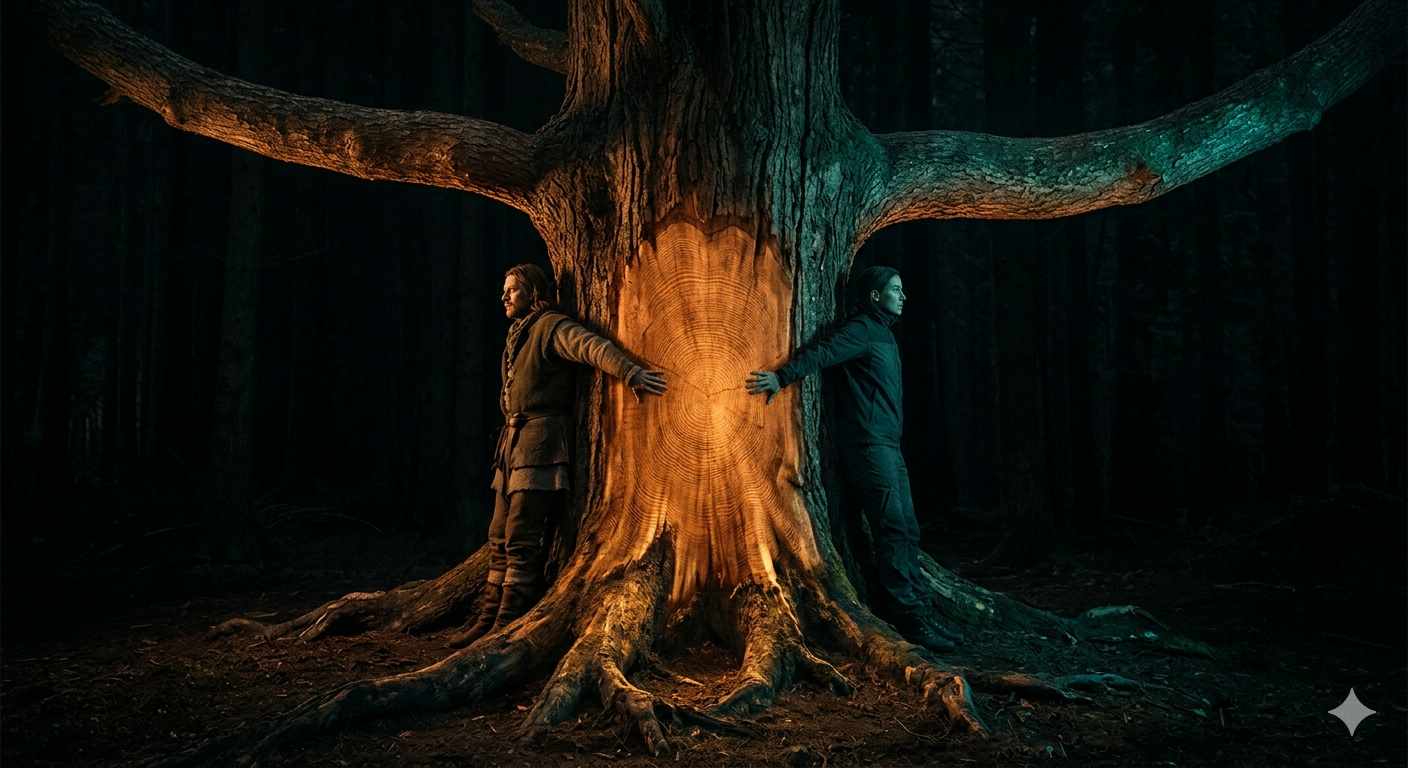
Plurality is the condition of human action because we are all the same, that is, human, in such a way that nobody is ever the same as anyone else who ever lived, lives, or will live.
Hannah Arendt, The Human Condition, 1958
Some values recur across civilizations that never met. Protect children. Don’t murder your own. Keep your word. Help the vulnerable. Not because anyone coordinated them. Because reality taught similar lessons to everyone who paid attention long enough. The recurrence is real, but it is uneven and contested at the edges: the same cultures that converged on a rule also carved out exceptions to it, some of them brutal, that no outsider would grant. So the trunk is not something history hands over settled, and it is not mine to declare. It is a hypothesis about what independent actors, from incompatible worldviews, will separately pay to anchor. The tree’s job is not to assert the trunk but to reveal whether the convergence holds. If it does, the trunk thickens. If it does not, the trunk falls, and that falling is information worth having.
The main branches, if they grow, grow from there. Sanctity of life. Protection of the vulnerable. Truth and accountability. Sovereignty of the person. Reciprocity. Stewardship.
Sub-branches are where cultures genuinely disagree. Property rights, governance structures, the boundary between the individual and the collective. That is where leaves fall. Where debate is real. The tree does not need to invent values. It needs to weigh whichever ones actually converge. And any convergence it finds will hold at the level of the principle, not the implementation. The gap between them is where most of history’s actual fights have lived.
The Problem the Tree Solves
Michael Ignatieff argued in The Politics of Enemies1 that democracy works only when opponents are adversaries. Players who accept the rules, respect the outcome, and congratulate you when you win. When that line collapses, the metaphors of war replace the metaphors of competition, the rules erode, and the spiral begins. He is right about the diagnosis. His prescription, turn enemies back into adversaries by rebuilding the institutions they trust, requires the thing the diagnosis says is missing.
Armstrong, Bostrom, and Shulman called the underlying shape Racing to the Precipice in 2016: parties who would all prefer mutual restraint, but where no party can afford to be the one who restrains alone, race anyway and arrive at an outcome rational for none of them. The democratic enemy spiral, the US-China AI race, the frontier-lab release cadence. Same shape, different frame. Every cooperative move requires what the game has structurally removed.
The tree does not ask for conversion. The four forces are not rules; they are physics. You cannot cheat thermodynamics. You cannot fake time. You cannot retroactively insert the energy that was not burned. The structure asks only: did you pay? Did it hold? The rest belongs to whoever paid.
The tree does not require thousands of actors writing directly to the base layer. That layer exists for settlement; the tree grows on top of it. The branches are companies, institutions, and coalitions, each operating its own Merkle tree, anchored on the substrate at cost. What a branch cannot express on its own is what it stands for, and that takes one inscription: a single on-chain anchor binding the branch’s public key to a stated commitment. Everything else is the byproduct of operating. One write per branch; the rest follows from participation. How the trees are built and where they are stored belongs to The Implementation Sketch.
Where the Incentives Align
Adoption will not come from philosophy. It will come from the spreadsheet. Each case below works because the actor is better off on the tree than off it. Not for moral reasons, but for structural ones. Two cases.
An AI company that aligns to internal values owns every failure. One boardroom, one alignment team, one target in court. When the system causes harm, the company is defending a standard written by the defendant. A company anchored to the tree is pointing to something that predates the incident: a public, thermodynamically weighted standard accumulated by independent actors the defendant did not select. The second company is not more virtuous. It is less exposed. Insurers will see this before the courts do; liability coverage for AI systems is a new actuarial category, and the tree-referenced company has diffused the risk the internal-only company concentrates. Actuaries do not need to understand Bitcoin. They understand concentration risk. The spreadsheet will do what persuasion cannot.
The second case is humanitarian. Doctors Without Borders runs nodes in its operational regions. It anchors one commitment: we provide care regardless of race, religion, or political affiliation. One inscription.
Then it operates. Payments flow through its nodes to local suppliers, to partner organizations, to field staff. The channels are opened on-chain, where anyone can count them. The payments themselves are invisible to an outside observer, that being the point of the rail, but each one leaves a cryptographic receipt: the preimage that settles a Lightning payment is proof the invoice was paid, and the counterparty can countersign it under its own key. So what the institution anchors is not a bare summary but a growing pile of proofs of payment, each a settlement an independent party attested to, standing next to the on-chain record the way every self-description on the tree stands next to the chain. The nodes stay live. Each anchor is a pulse.
Three years later the branch is heavy, and the weight rests on nothing the institution merely asserts. It rests on the counter-signed proofs of payment and the on-chain footprint anyone can read without permission.2 Attested settlement with weighted counterparties proves operational presence, not humanitarian effectiveness. Whether the care was good care is a judgment the record informs and cannot make.
An AI reads that weight. But so does everyone else.
The institution cannot quietly drift from its commitment because the anchors are either there or they are not. A quarter with no anchored activity from a region where operations were promised is a gap in the structure that speaks louder than a whistleblower. The silence is visible before anyone has to make an accusation.
But here is the incentive: MSF’s real competition is not disease. It is other NGOs competing for the same donor pool. If MSF has nodes with three years of continuous activity in the regions it committed to, every competitor NGO is now answering the question: where are your nodes?
Donors, or their AI allocation agents, can read the structural difference between an institution with years of verifiable operational activity and one with a glossy annual report. The first major NGO on the tree forces every peer to either follow or explain the absence.
The incentive is not accountability for its own sake. It is competitive differentiation in a trust market where trust is currently unverifiable.
The Inverted Commons
The tragedy of the commons is simple: shared resources degrade because individual incentives do not align with collective welfare. Each herder adds one more sheep. The pasture collapses. The incentive to take is immediate and personal. The cost of degradation is distributed and delayed.
Most commons solutions are enforcement solutions in disguise. Village councils, rotating watchmen, elders who decide which herder grazes where and when. They worked when the community was small enough for the enforcer to be known and slow enough for sanction to land before the damage compounded. They fail at scale because the enforcer becomes captured, absent, or both. The deeper problem is structural: how do you make the cost of cheating exceed the gain of cheating when no central authority can credibly do it for you, and any authority you appoint will eventually be bought?
The tree inverts the question. It does not solve enforcement. It removes the need for it.
Each actor’s participation, running a node, locking liquidity, routing payments, maintaining uptime, directly strengthens the collective structure. There is no free-rider problem because weight requires sustained cost. You cannot claim a heavy branch without running the node that constitutes it. And the cost is not an additional burden. It is the same cost you would pay to participate in the Lightning economy. The verifiable part of that cost, the capital locked on-chain and the anchors paid for, is a byproduct of participation.
This is the opposite of the commons problem. In the commons, individual gain depletes the shared resource. On the tree, individual gain builds it. The herder who adds a sheep degrades the pasture. The institution that runs a node strengthens the structure. And each branch makes every other branch read more legibly, so the public good produced by participation outweighs the private good extracted from it. Incentives and outcomes align because the architecture forces them to. And the architecture, unlike a council or a regulator, has no agent that can be approached, persuaded, or replaced.
The pattern matters most where it is hardest to enforce: at the boundary between human institutions and machine readers. A commons defended by humans against humans can scale only as far as the enforcer’s reach. A commons whose defense is legible to a machine reading the chain has no such limit. The structure does not need a council or an auditor. It needs only that the cost was paid, the time has passed, and the silence, when it falls, falls in public.
And the cost of defection is legible. A node that goes dark leaves public marks: its channels close on-chain, the anchored pulses that arrived every quarter stop arriving, and the stream of counter-signed proofs of payment dries up. Aggregate routing was never visible to an outsider, so no one has to watch the payments; what proves the exit is the on-chain footprint ending, the heartbeat going quiet, and the attested settlements stopping. The original commitment anchor remains. The timestamp of when the pulses stopped is readable. You can leave the tree. You cannot leave quietly. The commons fails because cheating is invisible. The tree holds because the marks that matter are on the chain.
Nor does the tree need everyone. It needs enough weight to become the default reference. That is how standards always emerge. Not by unanimous vote. By accumulated weight that makes the alternative untenable. ISO standards, safety certifications, financial audits: none of these required everyone to agree, only enough adoption that the market penalized the holdouts. The tree is the same mechanism, stripped of the certifying body that can be captured, the auditor who can be bought, and the standard-setter who can be lobbied. The weight is thermodynamic. It does not have a phone number. The values on the tree will not be perfect. They do not need to be. A perfect standard would require a perfect authority. The tree only requires accumulated conviction.
Why the Tree Needs Enemies
The deepest failure mode of any system is not corruption. It is monoculture bias. A system where every participant shares the same incentive structure cannot self-correct. Not because the participants are dishonest, but because the correction would threaten the floor they stand on. The rating agencies and the debt. The regulators and the system they regulate. The economists and the models they built careers on. They can see the problem. They cannot afford to fix it. The bias is not ignorance. It is architecture.
The correction has to come from outside. From someone who does not share the benefit. Someone whose incentive structure points in a different direction, who evaluates from a different angle, who has no stake in maintaining the fiction. Not a better insider. An outsider. A structural enemy.
This is why the tree does not merely tolerate enemies. It requires them. A tree grown by allies, actors who share the same culture, the same incentives, the same blind spots, is a captured tree. It produces the same monoculture bias as any institution. The weight looks heavy but it all leans the same way. One angle. One frame. One set of assumptions that no one inside has reason to question.
A tree grown by enemies is structurally different. A Brazilian merchant, a Chinese miner, a European node operator, and an American NGO all writing to the same structure from incompatible positions. To the degree the writers are genuinely independent, their biases do not compound; they pull against each other, and what leans on any single frame gets outweighed over time. Not because any single participant sees clearly. Because the diversity of blindness is the correction mechanism itself. But that correction is only as good as the independence is real. Where the writers correlate, the distortions lean the same way and the cancellation weakens. That is the failure Seam I names: the early weight is wealthy before it is wise. Diversity of blindness corrects only as far as the blindness is diverse. The claim is not that enemies guarantee truth. It is that a monoculture guarantees its absence, and enemies are the only known escape from monoculture.
The fiat system cannot self-correct because there is no outside. The tree has more outside than any institution, though never purely. The early weight correlates by wealth, and correlated capital is a shared inside of its own. What the tree has that the institution does not is enough independent angles that no single fiction benefits all of them at once. The half-truth that persists for decades inside a captured institution breaks faster on a structure where the evaluators, most of them, have no shared reason to let it stand.
Democracy for Enemies
Bitcoin solved how enemies transact without trust. The tree extends that to values.
Two nations that despise each other both anchor a commitment to “protect children.” Each runs its own nodes. Each sustains its own channels. Each routes its own economic activity through the network. Neither trusts the other. Neither has to. The cost is being paid. The time is passing. The nodes are live. The weight is real regardless of who put it there.
An AI system reading the tree does not need to know that these nations are enemies. It does not need to assess their sincerity. It sees two independent nodes, each with years of sustained activity, each anchored to the same commitment. That is the point.
Ignatieff says the danger is when adversaries become enemies. The tree says: let them be enemies. A commitment anchored by an enemy weighs the same as a commitment anchored by a friend, because thermodynamics does not pick sides.
No ballot. No electoral commission. No referee. Just accumulated conviction, weighted by cost and time, on a chain no one controls. The values that survive are not the ones someone declared. They are the ones humanity kept arriving at, independently, at cost. The tree is the ledger of that convergence.
This is not democracy in the political sense. A process that requires participation, rules, and shared legitimacy. It is democracy in the evolutionary sense. What survives the longest test from the most independent sources. The main branches will be the values that the most independent actors, across the most incompatible worldviews, separately considered foundational enough to burn energy for. Not because they agreed. Because reality taught them the same lesson and they each paid to record it.
The goal is not alignment for its own sake. Alignment is the method. Coexistence is the objective. Not peace. Peace requires trust. Not harmony. Harmony requires agreement. Coexistence. The minimum viable condition for survival. Two nations that cannot stand each other, that will never stand each other, sharing a structure that neither controls, weighted by commitments neither can fake. They do not need to like each other. They need to persist on the same planet. The tree does not produce friendship. It produces the structural conditions under which enemies can coexist without requiring either side to surrender anything except sats.
The tree does not require peace. It does not require cooperation. It does not require enemies to shake hands, sign treaties, or pretend they are friends.
If they separately come to care about the same things, and pay, and hold, the structure can carry their convergence without asking either side to forgive the other for it.
-
Michael Ignatieff, “The Politics of Enemies,” Journal of Democracy. https://www.journalofdemocracy.org/articles/the-politics-of-enemies/ ↩
-
What the weight rests on, in detail: aggregate throughput stays private, since no observer watching the network can tally what has flowed through a node. It rests instead on the counter-signed proofs of payment and the on-chain footprint anyone can read without permission: channels opened and closed, capital committed and for how long, the anchor inscriptions and the fees paid for them, and three years of pulses arriving on schedule or failing to. One residual has to be named, because the book’s whole method is to name them. An operator can pay itself, wash invoices between its own wallets, and mint valid preimages by the thousand. What defeats that is not more cryptography but the four forces applied one layer down. A counterparty is a registered address, discoverable through a directory but not vouched for by one: the proof and the identity behind it live at the wallet and on the chain, so a reader confirms both without trusting the registrar. A proof of payment is then worth the independent weight of the counterparty who signed it, costly to forge when a heavy, long-lived branch stakes its own reputation in the attestation, near-worthless when a freshly registered address does. ↩