I had been sitting with a question the last chapter left open, who else gets to write, when a paper from inside the alignment field named the underlying problem in a different vocabulary. Taylor Sorensen and her co-authors, at ICML 2024, published A Roadmap to Pluralistic Alignment, a piece of honest architectural thinking about what it would take to align an AI system to more than one perspective at once. They formalize three modes: present the whole spectrum of reasonable answers, be faithfully steerable toward a given position, match the distribution of answers a real population gives. Then they do the thing the field needs more of, and measure what the current method actually does. Across every model they tested, the models after alignment training were less similar to real human populations than the base models were before. The thing the field calls alignment, they show, empirically narrows. And the paper is honest enough to leave the load-bearing question on the table, in the limitations section, in the voice of people who know they cannot solve it from inside the model: “In creation of a general LLM, like ChatGPT, who is the target distribution?”
The field has no answer. Every proposed one folds back into the same shape. An Overton window requires someone to draw it. A steerable set of attributes requires someone to pick which attributes are admissible. A distributional target requires someone to pick the distribution. Three operationalizations, one unresolved question underneath all three: who curates? There is no way around it from inside the model. The way around it is the substrate the values get written into.
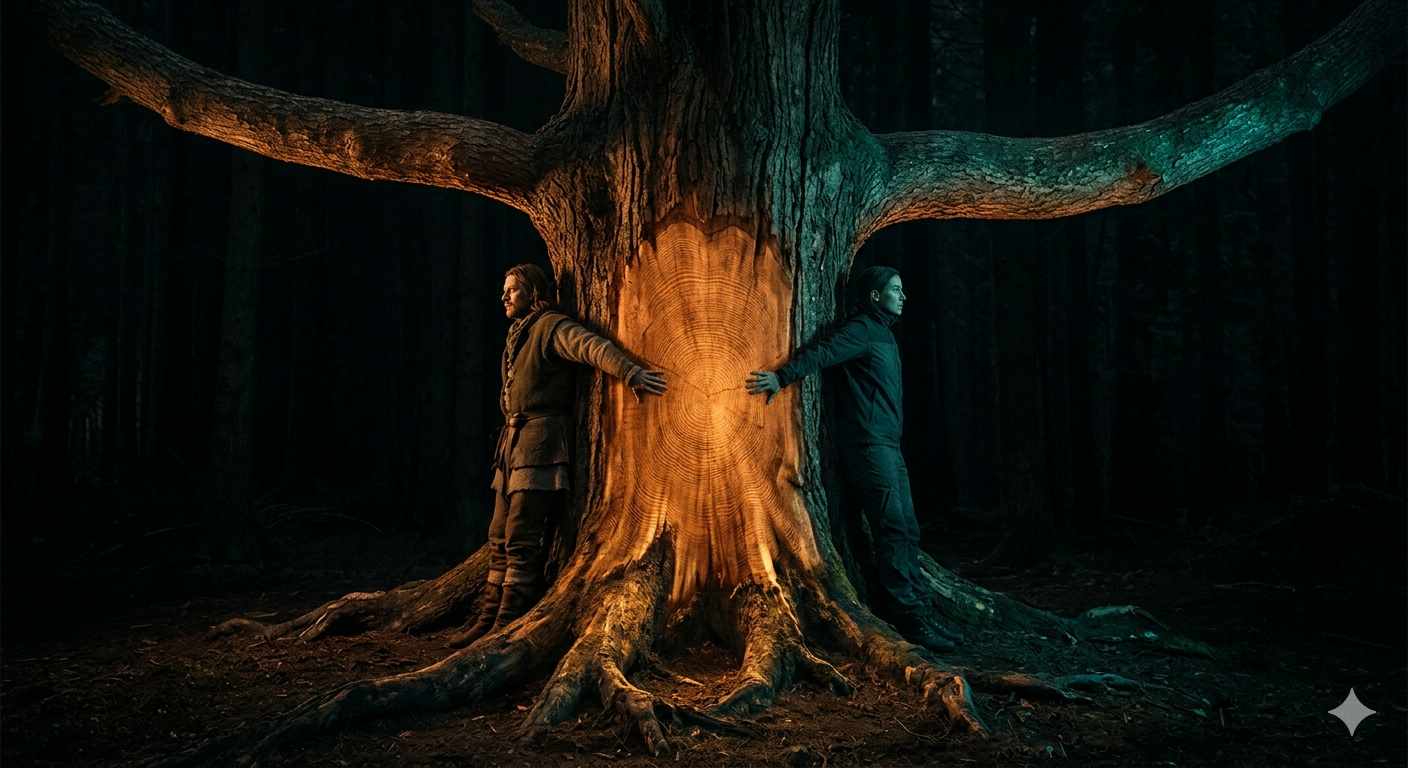
The Overton window is not a curator’s responsibility. It is the readable surface of a structure that bodies have inscribed into at cost, over time, from incompatible angles. What counts as a “reasonable answer” is what enough independent bodies paid enough to record and have not since outweighed. States with treasuries, institutions with budgets, communities with time. The window is not drawn. It is read.
Once payment and persistence are the only questions, the list of eligible writers gets longer than any existing political form is comfortable with. Institutions older than the modern state: universities, hospitals, scientific consortia, religious orders, each holding commitments older than any single member, carried in charters their own administrators can quietly reinterpret. A monastic order that has held the same Rule for a millennium has more time on it than any modern state, and has never had a substrate to say so on a record separate from its own archives. Past the institutions, the bodies the modern world refuses to register: an indigenous nation whose compact predates the state that refuses to recognize it; a diaspora scattered across six jurisdictions, pooling sats and running a node without any single government’s permission. Coalitions that are not a legal entity anywhere: farmers across three continents anchoring a commitment to a farming practice, investigative journalists across twelve countries anchoring source protection. Even a generation is a body in the relevant sense. It holds conviction in common that the next one may not share, and until now, the record of what a generation stood for has been written by whoever administers the archive after the generation is gone. The four forces ask whether the energy was burned. They do not ask for credentials.
And then they change their minds. A state changes governments. A council of a church revises a teaching. A constitution is amended. A scientific consensus shifts when the evidence shifts. In every existing system this is invisible: the new policy replaces the old, the website is updated, and the archive is curated by whoever is in charge after the change. The curator is the same hand that holds the eraser. On the tree, revision works the way the previous chapter said it does. Nothing is erased, and the new inscription stands beside the old. A state that anchored a commitment to a climate accord and has since stopped sustaining it does not get to pretend the commitment was never made. This is the feature, not the bug. Political bodies are supposed to be able to change their minds. What has never been possible is changing them in a way that is honest about the change. The tree does not freeze conviction. It makes drift legible. The body that held a position for forty years and then revised it is structurally different from the body that flips every cycle, and the structure shows the difference without anyone having to interpret it. A revision does not erase. It outweighs, or it fails to. The protocol is a scale, and what the scale guarantees is that nobody can pretend the prior reading never happened.
I cannot tell the bodies what to write. The architecture’s virtue is that nobody gets to.
That is what alignment looks like when nobody owns it.
Seven Seams
None of this is shipping. The architecture is sketched, not built; the inscription formats are imagined, not standardized; the readers, human and machine, that would treat the tree as ground rather than curiosity do not yet exist at the scale the argument requires.
The strongest test of an argument is not whether it can be defended. It is whether the person who built it can name the exact points where a hostile reader would push hardest, and hold their ground without flinching. Seven seams. Not strawmen. The real objections. The ones that kept the writers awake.
I. Wealth bias survives hard money. A sovereign wealth fund running a thousand nodes outweighs a thousand individuals running one. The four forces are neutral to the identity of the participant; they are not neutral to the resources of the participant. Piketty showed a decade ago that concentration is structural rather than monetary, and the tree does not escape that fact. The honest answer: this is true, and it resolves only partly, and only through time, the one force that cannot be forged. A fund that appeared last quarter cannot manufacture the weight of a node that has been live for three years, regardless of how many sats it locks. It can, though, buy one: an aged key with a deep history is a purchasable asset, and acquisition transfers the accrued time without resetting it. So time narrows the advantage of new money against old, but it does not close the advantage of money that buys the old. The advantage does not vanish. It narrows. In the current system, wealth bias compounds without limit and the correction mechanism does not exist. A slow correction beats no correction. That is the comparison class that matters.
II. The trunk is abstract. “Protect children” converges precisely because it is vague; the fights that produce actual enemies live in the sub-branches, in what counts as protection, from whom, at what age. Thin morality for strangers, as Walzer drew the line, with the thick fights living where they always have. The answer is methodological: the trunk is not declared but revealed by convergence, and if the convergence is not real the trunk falls, which is itself worth knowing.
III. After money, who mines? Block rewards halve to zero. Transaction fees pay what remains. In a post-money world, what pays the miners? No one can honestly answer the mechanism question across a century. Three possibilities, each with a price. Fees scale with adoption, which costs only certainty: a bet no one can model in advance. Patronage takes over: the parties with the most weight on the tree fund hashrate because their stake is worth more than the cost of defending it. Structurally the soundest, and the most expensive: the chain that anyone, anywhere, could secure becomes the chain that the parties with the most to lose secure on everyone’s behalf. Durable like the Domesday Book. No longer trustlessly defensible. A real artifact; not the artifact Satoshi designed. Or the energy regime itself changes, abundance dissolves the asymmetry proof-of-work depends on, and what secures the chain in that regime has no name yet. Who pays the miners? was never the real question. The real question is what the chain has to become to be paid for at all, and whether that is still the chain the early defenders cared about. The bet is being made by everyone who holds sats. The seam is not closed. It is named.
IV. The compass only works on agents that consult it. A misaligned AI has no reason to value thermodynamic proof over its own objectives, and a compass on the shelf does not keep the ship off the rocks. The answer is not a better leash but the environment: if most agents read the same ground, they function as a distributed immune system, and divergence becomes visible before it becomes terminal. The alternative is a single leash held by humans slower than the thing they hold. Less fragile, not bulletproof.
V. Weight is not meaning. The weakest link in the argument. An institution can anchor a commitment to “protect children” and run nodes for a decade, and the four forces will read the branch as heavy, without telling you whether the institution actually protected children. Only that it sustained costly participation while claiming to. Goodhart named the failure half a century ago: any measure made load-bearing starts to be gamed as a measure. What the tree offers is narrower, and worth stating precisely: it records, permanently and publicly, when you stopped doing what you said. And it records who else noticed. The weight is produced by the participant, read by the network, verified by physics; no one holds the pen that writes the grade. A slow, imperfect accountability mechanism that cannot be captured beats a fast, theoretically perfect one that always is. That is the argument. It is not a strong argument. It is the best one available.
VI. The timescale of rot. A pharmaceutical company anchors to “publish all trial data” and quietly suppresses a dangerous study for five years; the branch stays heavy the whole time, because the tree only records what is inscribed, and a suppressed study is not graded silence but just silence. The tree does not accelerate the discovery of fraud. It accelerates the consequences once fraud is discovered: the commitment is on-chain, the violation now public, the gap between them recorded where no one can edit it. On the tree, the lie stands beside the promise, forever. That does not help the people harmed before the branch falls. It shortens the recovery after, which is not the same thing.
VII. The mirror has a gate. The tool that made this book possible at its scope costs a subscription, requires reliable internet, and performs best in the languages of the economies whose writing was digitized earliest. The payment architecture in these pages was argued for on behalf of the unbanked. Most of the unbanked cannot reach the tool that composed the argument. The design principle the book applies to payment rails does not stop at them: infrastructure concentrates at every chokepoint it is allowed to create. The prescription is not invalidated by the instrument. But this book names its own weaknesses as a structural advantage, and that move obligates completeness. The access inequality of the mirror was visible throughout and was not named until a reader forced the question. The omission was not structural. It was chosen. That is a different kind of seam.
Seven seams. None obviously fatal to the diagnosis; three genuinely unresolved: what mining becomes after money, the gap between weight and meaning, the access inequality of the mirror. Naming a weakness does not close it, and those three do not close here. What holds regardless is the diagnosis, which is stronger than the prescription: centralized infrastructure is governance architecture, and every bottleneck becomes a point of capture, with or without the tree, because it describes what is already happening. The prescription is the best alternative currently on the table. Not perfect, and not proven. But an argument that surfaces its own faults before the reader does is one the reader can weigh honestly. In a landscape built on manufactured justifications for capture, that is worth something. Not because honesty makes the argument true. Because it lets you see exactly where it might not be.
The seams are open. The thread is live. The process continues.
The Bodies That Believe section is in conversation with Taylor Sorensen, Jared Moore, Jillian Fisher, Mitchell Gordon, Niloofar Mireshghallah, Christopher Michael Rytting, Andre Ye, Liwei Jiang, Ximing Lu, Nouha Dziri, Tim Althoff, and Yejin Choi, “A Roadmap to Pluralistic Alignment,” ICML 2024. The paper formalizes the three operationalizations of pluralistic alignment, reports that current alignment techniques compress distributional pluralism against the human populations measured, and leaves the question of who selects the target population unresolved.