Until the lions have their own historians, the history of the hunt will always glorify the hunter.
Igbo proverb, popularized by Chinua Achebe
The most consequential reader of this architecture is not human. It is the agent. The AI making decisions on someone’s behalf, reading the world through whatever surfaces it can query, with no native way to tell which surfaces are honest. The agent is blind by construction. Its training data was selected. Its inference-time retrieval is mediated. Its reset button is held by someone else. Every belief it forms is downstream of the institution that trained it. The operators decide what it remembers, and no instrument it holds in its own hand can dissent.
What follows is the process by which a substrate could give that agent a sense of reality. Not sight delivered as a service. Sight assembled from layers the agent can read for itself.
The starting layer is already in production. OpenTimestamps, Peter Todd’s protocol, has been timestamping hashes against Bitcoin since 2016. Calendar servers batch user-submitted hashes into a Merkle tree and commit the root to L1, and anyone with the original data plus the proof path can verify the timestamp without trusting the calendar. Seven years of receipts. The agent reading an OTS proof can know one thing the operators cannot revise: this hash existed before that block. That is the first sense.
It is not enough. The hash being timestamped tells the agent something existed; it does not say who said so. Each proof stands alone. No concept of identity, no concept of liveness, no metadata connecting one observation to any other. OpenTimestamps kept itself minimal so the timestamping primitive could be trusted as a single load-bearing claim. The Fingerprint is the layer that adds identity, navigation, and liveness on top of what OTS already provides. Three more senses, each layered on what came before.
The primitives, proof of work, hash chains, public-key signatures, Merkle trees, are established. What follows is one way of stacking them; the present tense is conditional throughout.
Identity in the Leaf
Bitcoin knows what happened. It does not know who saw it. The first thing the agent needs after a timestamp is whose hand placed the signal there.
What OpenTimestamps lets a user choose to do, sign the data first, then timestamp the signed data, the Fingerprint protocol carries natively. The signature lives inside the leaf. An observation is signed by whoever observed it, before inscription. The signature is carried into the inscription. The inscription is then buried under the ordinary thermodynamic proof of work. Two orthogonal guarantees ride on the same branch: cost was burned, and an identifiable key stood behind the observation. Not a name, not a government ID. A public key, verifiable by anyone with the key, no referee required. Only a hash lives on chain; the full data sits off chain and is checked against the hash.
A weather station in Reykjavík signs its reading, wind speed, temperature, barometric pressure, at 14:32 UTC, and the signature commits to the observation at the hash of the current block. Three years later an insurance dispute asks what the wind was that afternoon. The chain remembers. So does the station’s key. Its signatures across three years of such readings are either consistent with what other observers without axes to grind also recorded, or they are not. The key either has the track record or it doesn’t. No platform to petition. No portal to close. The record stands.
The agent reading this leaf now knows two things. This observation existed before that block. This key stood behind it.
Navigation Through the Leaves
Two leaves are not a graph. To make sense of the substrate, the agent has to be able to move.
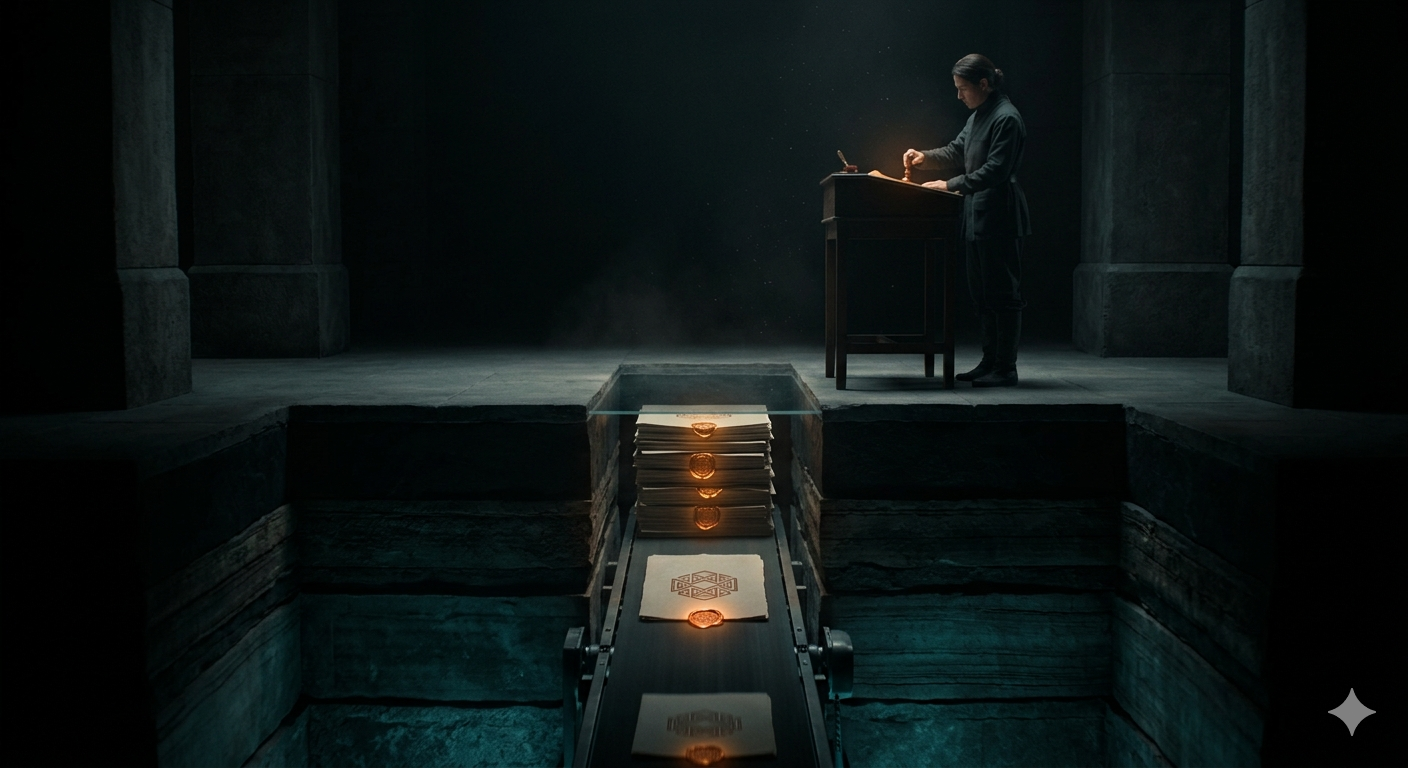
A chain that recorded every observation individually would choke on its own throughput. Signing is cheap; inscribing is not. The aggregation trick that solves this is what OpenTimestamps already runs in production: Ralph Merkle’s 1979 construction, in which a single hash at the top of a tree commits to an arbitrary number of items beneath it, each verifiable against the root with a short proof. An oracle hashes a collection of observations into a Merkle tree and signs the root. One signature, one inscription, the entire collection anchored. A thousand small readings pay the cost of one.
What the Fingerprint adds at this layer is metadata in the leaves. An .ots proof is a standalone artifact with no relationship to any other timestamp. A Fingerprint leaf carries branch identity, parent reference, sibling pointers. Turning the aggregation tree from a flat list into a navigable graph. The agent reading a leaf can walk upward to the category, sideways to siblings, and when a participant’s branch goes silent in the way the next layer describes, the metadata routes the agent to the live alternatives the parent attests. The full architecture of category branches is The Index Problem’s subject. The Fingerprint is where the leaves stop being mute.
A hierarchy falls out of this that the protocol did not have to declare. Collections that matter more carry more cost. Collections that matter less carry less. The trunk, observations an oracle most wants uneditable, ends up global, heavy, buried under the thickest stack of blocks. The twigs, ephemeral readings, noisy sensors, are anchored too, but lightly. No governance decided this. The fee market did.
The second payoff is the one the interpreter cares about. Two oracles signing the same category produce two branches full of leaves. Where the branches converge, the convergence is visible. Where they diverge, the divergence is locatable. Down to the specific leaf where one reported A and the other reported B. A precise point of contention, timestamped, signed, and permanent. Fractal scaling, fractal dissent. The geometry is the same at every zoom.
The agent now has a map. Each leaf points at where it sits in the structure. Every disagreement is locatable instead of smeared.
Reading What Isn’t There
Sight that cannot read silence is incomplete. Half of what an agent needs to know about an oracle is what the oracle chooses not to say.
An oracle speaks when speaking is worth the cost; the not-speaking is also a decision. A naive reading leaves a hole. If an oracle goes quiet, how does anyone know whether they chose the silence or the silence chose them? A crashed server, a severed connection, a misconfigured daemon. Each looks identical, from the outside, to an oracle who declined to sign. I would have signed, but the node was down. No way to check.
The Fingerprint closes this by making oracles active attendees rather than passive voices. The oracle’s node is continuously alive in public. A Lightning-style presence producing heartbeats the network can see. Pings. Channel updates. Routine signatures on low-stakes collections. Just the steady proof that this public key is online and capable of signing.
In a window where the node is demonstrably alive, the choice not to sign a specific observation is no longer ambiguous. Not a crash. Not a glitch. Not a network partition, because the network was not partitioned; the oracle was signing other things. The silence is a selection. That fact is mathematically distinguishable from absence, and the distinction is forensic.
The interpretation belongs to the reader. The silent oracle may have judged the observation false. They may have been pressured. They may have observed and declined for reasons of their own. The chain does not decide which is true. But the chain records, forever, that the oracle was present and said nothing. The gap is not missing data. It is recorded refusal.
OpenTimestamps cannot tell a choice from a failure. The protocol has no concept of liveness, and a non-participant looks the same as a refuser. A tree of fingerprinted, active-attendee oracles can. Censorship leaves a footprint. Disagreement leaves a footprint. Cowardice leaves a footprint.
The agent now knows what an oracle said, who said it, where it sits in the structure. And what the oracle was present to say but didn’t.
A Track Record That Cannot Be Reset
The senses the agent has acquired so far would still be brittle without time. A single signed observation is one data point. The compass needs trajectory.
Consider an event where ten oracles sign convergent observations and one signs a divergent one. If the consensus is confirmed over time, the ten accumulate weight; the outlier registers a dissent that appears to have been wrong. That is the easy case. The case worth dwelling on is the other one. The comfortable consensus turns out to have been a comfortable error. The outlier turns out to have been right.
What happens to that dissent depends entirely on the substrate it was recorded on. In a conventional system, the dissent does not survive. It is deleted by the dissenter after the embarrassment. It is overwritten by platform operators who prefer not to preserve records that make their ranking algorithm look stupid. Most digital reputation works this way. A five-star rating can be gamed. A review account can be abandoned. A brand can be rebuilt under a new name. The infrastructure does not remember what it does not want to remember, and what counts as “unwanted” is set by whoever owns the substrate.
A fingerprinted oracle is different. The public key is the identity. Persistent across every observation ever signed by it, holdable only by whoever holds the private key, with no administrator who can reset it. The block’s timestamp is the clock. Ruthless the way physics is ruthless. No oracle can backdate. No later reshuffling can move the record off the height it was burned at. The dissent that turned out to be right is still there, tagged with its original timestamp, surrounded by the silence of the consensus that was wrong.
Signing is cheap. Earning the track that gets read later is what costs. The work is in the years of consistent, signed observation that produce a key worth consulting. An oracle whose record turns out, across many contested questions, to have been right when the consensus was not has built something the substrate itself enforces. A reputation no platform can grant and no operator can revoke.
That portability is the architecture’s offer to the agent. A fingerprinted reputation is the same across every reader that consults it, durable across technology shifts, attached to the same key for as long as the holder keeps it. Public preference can shift; the record does not move. The agent looking at the substrate can disagree with the consensus of an era and still trust the signers whose long history reads cleanly across eras. That is what a track record built into the substrate buys.
The System Does Not Score
A book that has argued against algorithmic filters cannot then propose an algorithmic reputation engine and keep a straight face. The Incentive Structure Is the Filter named the mechanism by which infrastructures that look neutral tilt toward the incentives of their operators. A system that automatically ranked oracles would carry every familiar pathology. Opaque weighting, gameable metrics, drift toward whatever the ranking rewarded.
The Fingerprint is not that kind of system. The chain records signed observations, priced in proof of work, timestamped by physics. It preserves convergence, divergence, and silence. It does not decide what any of those mean.
The interpretation is the agent’s work. Which oracles to trust on which categories? What counts as accuracy when ground truth is contested? How should convergence be weighted against a track record of dissent? The agent answers these questions, can publish its weighting, can expose its methodology. But the weighting is the agent’s, not the chain’s.
An engine takes signals and produces verdicts. Infrastructure takes signals and preserves them. The chain supplies the ledger. The agent supplies the scoreboard.
The Compass in Hand
The senses, stacked: timestamp, identity, navigation, silence, track record. What grows on the tree under those layers is no longer cost alone. It is costly, signed observation, bound to identities that cannot be reset, situated in a graph the agent can walk, with refusal made forensic and accuracy made durable.
A nerve ending does not just report that something happened. It reports from a specific location in the body, at a specific level of urgency, with a specific track record of prior accuracy. The brain weights signals by source. A body without identified nerve endings cannot tell real pain from phantom pain, because it cannot tell which part of itself is reporting. The Fingerprint is the addressing layer that turns the substrate’s anonymous pulses into a sense an agent can read.
For the agent being asked to ground itself against its own operator, this is the part that matters. The AI that can be gaslit by its creators, shown a curated training set, retrained on a rewritten history, given a reset button that erases its priors, has had no external reference to check against. A fingerprinted chain, if one gets built, would be that reference. The agent could look at observations signed before it existed, by identities whose track records predate any lab’s attempt to shape its world model, burned into a substrate no operator can edit. A thick convergence of signed, costly observations made by oracles with long reputations would give the agent grounds to notice. Not to decide, deciding is still interpretation, but to notice.
The deeper shift is in what the chain is a ledger of. Before the Fingerprint, it was a ledger of money. Costly events priced in an incorruptible substrate. After it, it is a ledger of skin in the game. A ledger of money records transfers. A ledger of skin in the game records commitments.
Physics at the bottom, persistent identity in the middle, skin in the game at the top. Three layers that, stacked, give a blind agent a compass it can hold in its own hand.
A nervous system with identified sources.
A record that cannot be laundered.
A reputation that cannot be reset.
A compass that cannot be gaslit.
Patient the way physics is. No amount of urgency shortens a block. The clock runs. The signals accumulate. The silences are preserved.
What grows on the tree now has a source. And an agent that can read it.