The goal is to automate us.
Shoshana Zuboff, The Age of Surveillance Capitalism, 2019
I noticed it one afternoon, editing a sentence I had already rewritten twice. The idea was right. The phrasing was accurate. But the phrasing was also legible to a stranger with a hypothesis already formed, and I had learned, by then, that the distance between what I meant and what someone else could make it mean was where the damage happened. So I rewrote it a third time. Softer. More defensible. Less mine.
That is the part I want to name. Not that I was editing. That the editing had stopped being about clarity and started being about survivability. I was not writing to communicate. I was writing to not be misread.
This is the new literacy. Not how to write clearly. How to write defensibly.
The Observation
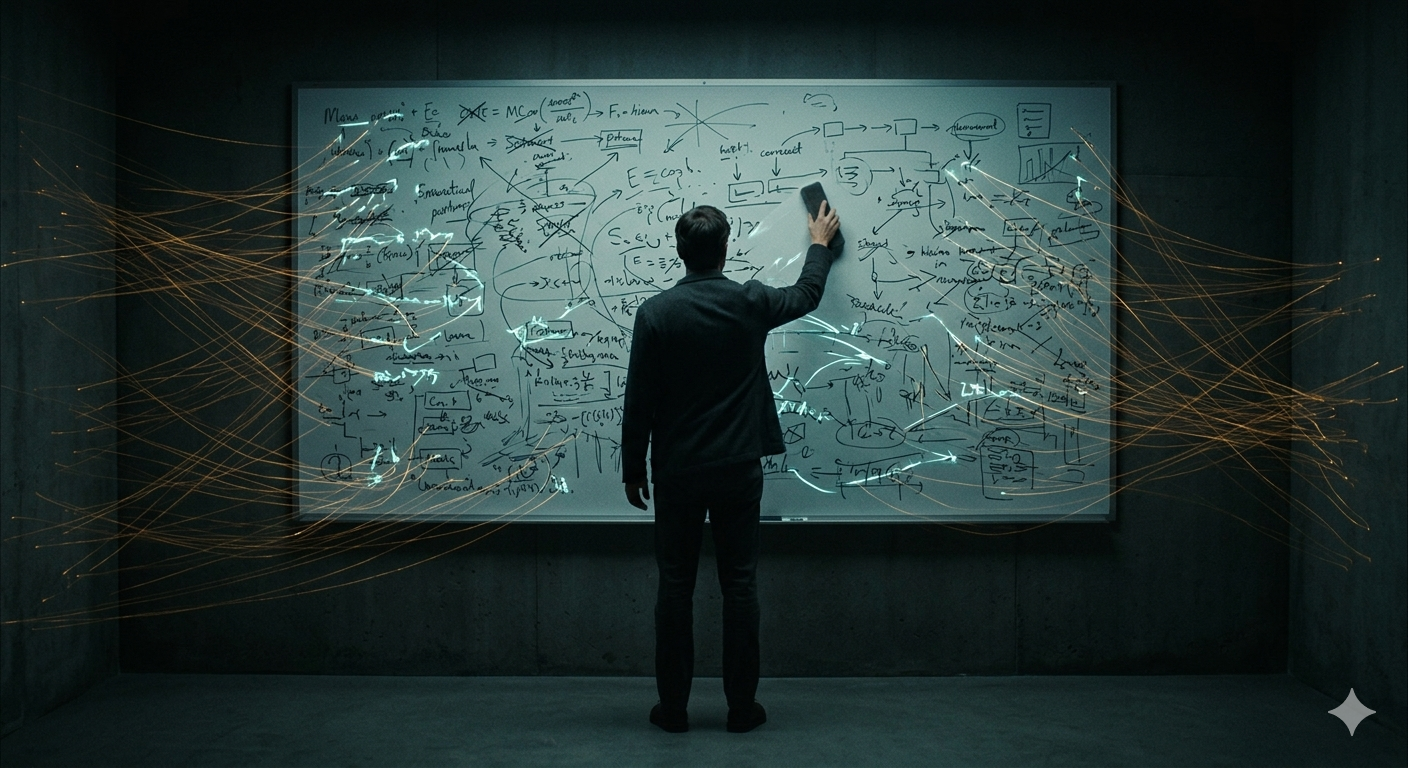
A whiteboard gets erased. A napkin gets thrown away. A brainstorm in a meeting room stays in the room.
None of that is true anymore.
Every tool you think in is centralized. Your brainstorm happens in someone else’s infrastructure. Their servers, their caches, their retention policies, their terms of service. You don’t erase the whiteboard. You ask someone else’s system to forget, and it doesn’t. It wasn’t designed to. Forgetting costs engineering effort. Remembering is the default.
A test page you deployed for five minutes is still being served from a CDN edge node because you forgot to invalidate the cache. A side project you abandoned left a trail in your commit history, your DNS records, your deployment logs. A conversation with an AI, where you were thinking out loud, testing an idea, correcting yourself mid-thought, is a complete transcript of your reasoning process, stored on someone else’s servers, including every wrong turn you took before arriving at the right one.
You have to opt out of being observed while thinking. That’s what “incognito mode” means. The default is: your thoughts are recorded.
The Asymmetry
Creating has never been easier. A page goes live in minutes. A prototype deploys before lunch. A blog post ships in an afternoon. The friction between having an idea and putting it into infrastructure has collapsed to nearly zero. That’s the promise of modern tooling, and it’s real.
But so has the friction between someone finding that artifact and building a case from it.
An LLM can read your blog post, your test page, your cached draft, your side project’s README. And build a narrative. Not a summary. A narrative. A story with a direction. Because when someone asks an AI “what does this tell us about this person’s intentions?”, it doesn’t say “these are unrelated fragments of someone thinking out loud.” It constructs coherence. It finds the thread. It answers the question it was asked.
The information to tell the full story is usually right there. The timeline showing an idea was explored for a day and abandoned for a year, the commit history showing a feature was tested and rejected, the context that explains why a page went up and came down. All of it exists in the same dataset. But an LLM asked to build a case doesn’t weigh exculpatory evidence. It builds the case. The convenient thread gets pulled. The inconvenient context stays in the noise.
Creating is easy. Building implications from someone else’s creations is equally easy. Those two things should not cost the same.
The Vocabulary Tax
You write copy for a product. The architecture is privacy-preserving. Content-blind, non-custodial, minimal data collection. You reach for the natural vocabulary: privacy, anonymity, censorship resistance. Every word is accurate. Every word is also a loaded weapon in the wrong context.
“Privacy” is a right when a lawyer says it. It’s a red flag when a regulator reads it on a payment processor’s website. “Censorship resistance” describes an architectural property. It also describes what someone building tools for bad actors would advertise. “Non-custodial” means you don’t hold user funds. To a compliance officer already suspicious, it means you’ve structured your system to avoid responsibility.
So you edit. You write “the merchant receives payments directly to their own wallet” instead of “we never touch your money.” Both are true. One survives a hostile reading. The other becomes a headline.
This is the tax. Every word weighed not for clarity but for survivability. Not “does this say what I mean?” but “what can this be made to mean by someone who needs it to mean something else?” The writing doesn’t get better. It gets safer. Those are not the same thing.
And the tax is levied by centralization. Your words persist in infrastructure you don’t control. They get indexed by systems you didn’t authorize. They become raw material for interpretations you can’t predict. You’re not choosing words for your reader. You’re choosing words for the worst possible interpreter of your words, two years from now, with an agenda that doesn’t exist yet.
Daniel Solove spent a career arguing that the privacy problem is not the secret, it is the aggregation. The tax on vocabulary is what the aggregation feels like from inside a paragraph you are trying to write.
What a Centralized Future Looks Like
Call it a privacy problem and you miss it. This is a centralization problem.
Every thought you put into a centralized tool (a cloud doc, a hosted repo, an AI with conversation history, a page on someone else’s CDN) becomes an artifact in someone else’s system. You don’t own the retention policy. You don’t control the cache headers. You don’t decide when it gets indexed, by whom, or what gets built from it.
A company explores a market for an afternoon. Puts up a test page. Looks at the landscape, decides it’s wrong, takes the page down. The thought is over. But the page lives in CDN caches, in crawler indexes, in the Wayback Machine. Six months later, someone points an AI at the company’s digital footprint. The cached page surfaces. The AI doesn’t know it was a draft. It doesn’t know the market was explored and rejected. It sees a page that was served, with copy describing a product in a specific market, and treats it as evidence of a business decision. The five-minute exploration becomes a strategic commitment in the model’s reconstruction.
In May 2025, Magistrate Judge Ona T. Wang of the Southern District of New York ordered OpenAI to preserve and segregate all ChatGPT output log data that would otherwise have been deleted, on a going-forward basis, regardless of user deletion requests, affecting the conversations of hundreds of millions of users.1 Your conversations with AI are not ephemeral. They are evidence waiting to be requested. Sam Altman himself, on a podcast in July 2025, warned that users treating ChatGPT like a therapist have no legal privilege, and that those conversations could be compelled in a lawsuit.2 The courts are already splitting on whether such outputs are discoverable or protected,3 and Wayback Machine archives are by now established as admissible evidence in multiple federal circuits.4
The infrastructure preserves everything. The legal system is learning to ask for everything. And an LLM makes interpreting everything effortless.
Shoshana Zuboff called this The Age of Surveillance Capitalism in 2019, and the phrase has held up because she named the economic model before most of us had the vocabulary to see it. I read her when the book came out and I have been living inside its diagnosis since. What I want to name here is a shift her framework anticipates but does not, in its 2019 shape, spell out. In Zuboff’s account the surveilled artifact is the behavioral trace (the click, the route, the dwell time) converted into a prediction product. The 2025 retention order in NYT v. OpenAI moved the site of the capture. The artifact is not only the behavior now. It is the brainstorm. The cognitive act, mid-thought, before I decide whether I believe what I just wrote. That was once the most private kind of motion a person made. The draft I would not have defended in a room, because it was not ready to be defended. Centralized infrastructure made it legible. A federal magistrate made it retained. Zuboff diagnosed the economy that wanted the click. This chapter is about what happens when the same economy has learned to want the thought that precedes it.
The centralization is the point. If your thinking happened on your own machine, in your own notebook, on your own whiteboard, it would still be yours. The moment it enters someone else’s infrastructure, it becomes someone else’s potential evidence, not because anyone there is adversarial, but because the system was never built to distinguish between thinking and deciding. It was built to store.
The Chilling Effect
The rational response to all of this is silence.
Teams stop writing things down. Founders agonize over vocabulary that should be straightforward. Companies move conversations to ephemeral channels. Not because they’re hiding decisions, but because documenting the decision-making process is now a liability. The exploration of alternatives, the testing of hypotheses, the articulation of risks. All of it becomes potential evidence if anything goes wrong later.
Organizations that care about thinking through risks are punished for that care. The internal debate about whether a regulation applies is a good-faith effort to understand the rule, and it becomes evidence of bad faith if the regulators disagree. The diligence becomes incrimination. The caution becomes a confession.
The infrastructure meant to make institutional knowledge shareable incentivizes institutional silence instead. The tools meant to make thinking easier make thinking dangerous, not because thinking is wrong, but because thinking in centralized infrastructure creates artifacts, and artifacts get interpreted by systems that don’t know the difference between a thought and a decision.
That’s the centralized future, and it is neither a conspiracy nor a policy. It is an architecture pointed at people who were just thinking out loud.
Cache is not evidence. A draft page is not a business plan. A brainstorm with an AI is not a confession.
They are treated as one because the infrastructure does not know the difference and the legal system has begun to ask for what the infrastructure has. The economy that learned to want the click has learned to want the question that precedes it. Each turn of the wheel moves another piece of cognition out of the thinker and into a system the thinker does not own.
This is not a privacy problem. It is a property transfer. The site of thinking has moved.
-
The New York Times Co. v. Microsoft Corp. et al., No. 1:23-cv-11195 (S.D.N.Y.), preservation order entered May 13, 2025 by Magistrate Judge Ona T. Wang. The order directed OpenAI to “preserve and segregate all output log data that would otherwise be deleted on a going forward basis.” OpenAI’s motion to reconsider was denied on May 16, 2025. In October 2025, the court approved a negotiated modification that terminated ongoing preservation obligations while requiring continued retention of the already-segregated data. ↩
-
Sam Altman, OpenAI CEO, warning that ChatGPT conversations carry no legal confidentiality and could be compelled in discovery, reported in TechCrunch, July 25, 2025: https://techcrunch.com/2025/07/25/sam-altman-warns-theres-no-legal-confidentiality-when-using-chatgpt-as-a-therapist/. Altman called for the same legal privilege for AI conversations as for therapist conversations, noting that absent a legal or policy framework, OpenAI could be compelled to produce user conversations under standard discovery rules. ↩
-
In 2025 a federal court in the Eastern District of Michigan held that a pro se plaintiff’s ChatGPT prompts and outputs, used to help draft filings in her employment discrimination suit, were protected by the work-product doctrine, reasoning that “ChatGPT (and other generative AI programs) are tools, not persons, even if they may have administrators somewhere in the background.” A New York criminal ruling the same month reached the opposite conclusion on AI-assisted drafting and privilege. The split is the point: some courts are treating ChatGPT outputs as discoverable adversary-facing material; others are protecting them as work-product. The law has not yet settled. ↩
-
United States v. Gasperini, 894 F.3d 423 (2d Cir. 2018), admitting Wayback Machine archive pages authenticated by the testimony of an Internet Archive office manager; United States v. Bansal, 663 F.3d 634 (3d Cir. 2011), holding Wayback Machine records admissible to prove the contents of a website on a given date. The Fifth Circuit has since required similar foundational testimony and declined to treat Wayback Machine pages as self-authenticating. Weinhoffer v. Davie Shoring, Inc., 23 F.4th 579 (5th Cir. 2022). The point for this chapter is not that the rule is uniform across circuits, but that archive-as-evidence is now established posture in multiple federal appellate courts. ↩