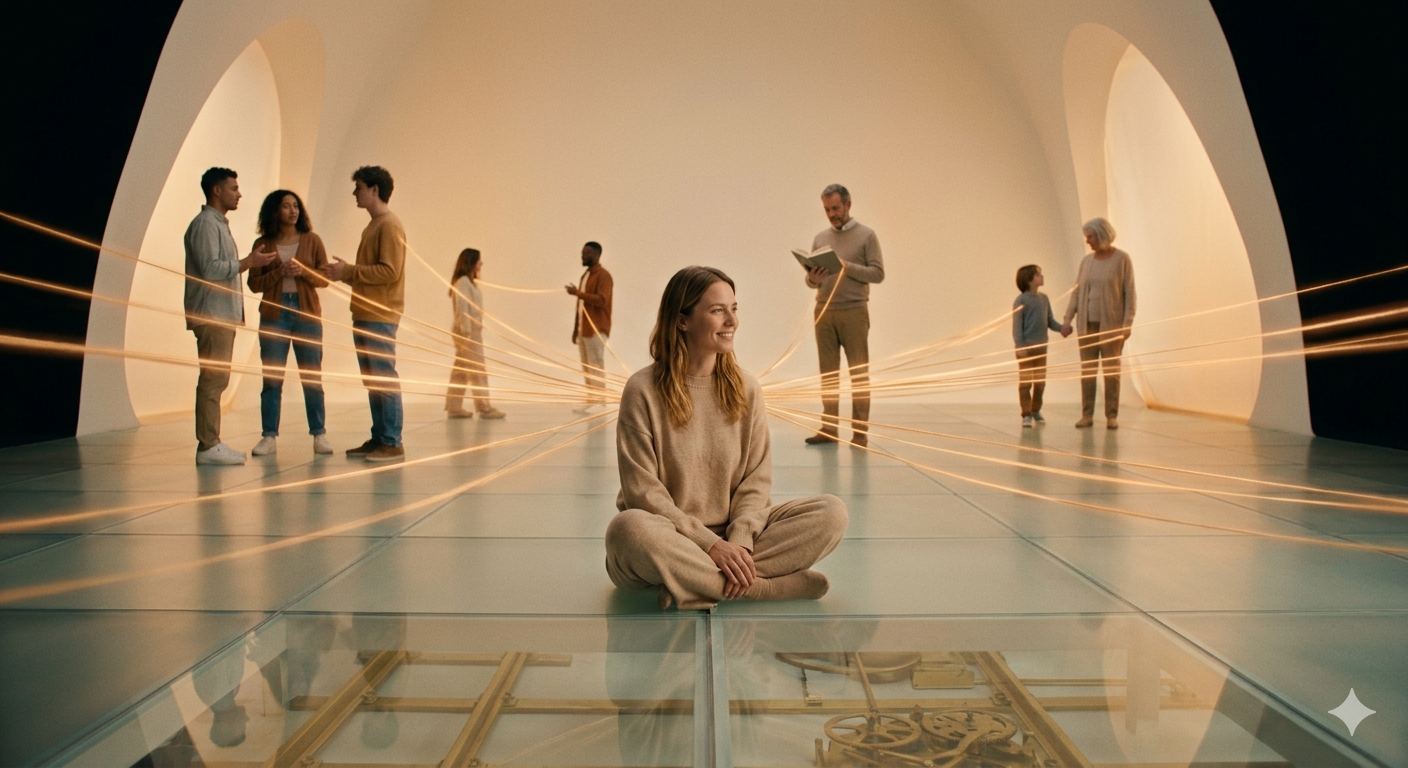
The thought did not start with Bitcoin. It started with Star Trek.
The Federation has no money. The show is explicit about it. Money doesn’t exist in the 24th century, Picard explains in First Contact. People work to better themselves and the rest of humanity, not to earn. The thing that makes the arrangement possible is built into the wall of every starship. The replicator assembles matter on demand, so the goods people once fought over stop being scarce. Remove the scarcity and you remove the problem money was invented to solve. The writers did not argue the point. They built a world on the far side of the economic problem and let the characters live in it.
For most of the show’s run that detail reads as set decoration. Against the curve the AI labs are now climbing, it reads as a forecast.
The Curve
The AI systems being built today are primitive. They predict tokens. They hallucinate. They cannot tell you what time it is. But they are improving on a curve every engineer in the field knows is not slowing down. The systems being built tomorrow will manage supply chains, allocate resources, conduct research, compose music, design infrastructure, negotiate on behalf of nations. The systems being built after that will do things we do not yet have language for.
Follow the curve far enough and you reach the place every futurist either celebrates or fears: the point where machines handle the work. Not some of it. The work. Production, distribution, logistics, creation. The things humans spent ten thousand years organizing economies around.
At that point, money, as a coordination mechanism for human labor, becomes unnecessary. Not worthless. Unnecessary. If machines produce everything and allocate it efficiently, the elaborate system of prices, wages, and markets that humans built to coordinate scarcity dissolves, not overnight and not by decree. It just stops being the most efficient way to organize things. Or it never quite does: energy, land, and attention stay scarce in any future, someone still owns the machines, and everything in this section should be read as speculation about how far the curve runs, not as a schedule.
And every monetary thesis for Bitcoin dissolves with it.
Store of value. Against what, when scarcity itself has been solved? Medium of exchange. Between whom, when production is automated? Unit of account. Measuring what, when the thing being measured no longer needs measurement?
If Bitcoin is money, then Bitcoin ends when money ends.
Three Thinkers, Two Thousand Years
Aristotle reached the question first. Politics, Book I, Chapter 4. He was trying to justify the arrangement of slavery in the Greek household, and he wrote a sentence that is still the cleanest statement of what automation does to labor-based arrangements of any kind. If the shuttle would weave and the plectrum touch the lyre without a hand to guide them, chief workmen would not want servants, nor masters slaves. He meant it as a thought experiment about the slave’s position: the master kept a slave because the work required a hand, and if the hand stopped being required, the position had no premise. Two thousand three hundred years later the same thought experiment lands on money, because money is what free labor uses to coordinate through markets. Remove the scarcity of labor and the coordination instrument loses its purpose. Aristotle could not see the shuttle he was describing. He could see the shape of what the shuttle would make obsolete.
Karl Marx reached it from the other direction, in the Fragment on Machines buried in his notebooks. The Grundrisse, written in 1857–58, went unpublished in his lifetime and untranslated into English until 1973. Marx is working through what happens when the machine becomes the direct producer instead of the laborer: the labor theory of value, that the time a worker spends determines a commodity’s worth, falls apart. “Labour time ceases and must cease to be its measure,” he writes, “and hence exchange value must cease to be the measure of use value.” Borrowing Marx’s eye for what machines do is not borrowing his program for what should come after; the rest of this book is the market-based architecture I believe in for the world I actually live in. When the machine becomes the producer, the measure the old system was denominated in stops being what measures wealth.
John Maynard Keynes reached it third and last, in 1930, the darkest economic year the century had produced. Britain in a depression, America sliding into one, Weimar in its last convulsion. Economic Possibilities for Our Grandchildren is ten pages written into that darkness and looking past it. Keynes believes the economic problem, the struggle for subsistence that every arrangement of human coordination has been organized around, is not the permanent condition of the species. It is a phase, ending when productivity rises high enough that meeting basic needs becomes trivial, which he estimated, in 1930, would take about a hundred years. He missed the timeline; distribution kept the struggle alive in ways he did not predict. He did not miss the argument. What solves the economic problem is the same thing Aristotle imagined and Marx described: the machine becoming the producer. The curve Keynes drew from a distance is moving in front of us.
Three writers. Two thousand three hundred and fifty years between the first and the last. Each working into the darkness of his own century, each describing the same horizon from a different angle. A horizon in which the coordination problem that gave money its position has been answered by tools none of them lived to see.
After Money
So here is the observation the rest of this chapter rests on. If the curve lands, the monetary thesis is not the substrate. It is a contingent use case resting on one. The chain is still there after money stops being what it runs on, because the chain was never only money. It is a record. Block by block. Page by page. What looked like a store of value was, underneath, a record.
The monetary thesis says Bitcoin stores value. The clock thesis, laid out earlier, says Bitcoin is time.
But a clock just ticks. Bitcoin is not just a clock. It is a journal. Every block is a page someone burned energy to write. Every inscription is a line someone considered worth the cost of making permanent. The clock tells you when. The journal tells you what.
The journal is already running. People write non-monetary data to the chain now. Art. Archival text. Timestamp proofs of authorship. Hash commitments to scientific results. The provenance of the training corpora that fed the models whose outputs someone will need to verify later. Most of this use is clumsy. Some of it is speculative noise. That is not the question. The question is whether the mechanism works. It does. The chain accepts what pays for a slot and preserves what it accepts, for as long as the chain keeps running. The use cases will evolve. The preservation does not have to.
And the journal was the first thing that happened.
January 3, 2009. Satoshi Nakamoto mined block zero, the genesis block, and put a sentence inside it. Not a transaction. A line from that morning’s Times: “Chancellor on brink of second bailout for banks.” A date. A place. A witness statement. The first block the chain ever carried was not a ledger entry. It was a page. A headline someone considered worth the cost of anchoring into a substrate nobody could rewrite.
The journal was not a later use. The journal was in block zero.
What has happened since is that the monetary argument has been won, repeatedly, on top of the journal. Bitcoin became money because the property that makes a good journal (persistence at cost, unforgeable, open to anyone willing to pay the price of a page) is also the property that makes a good unit of account. The tree of proof I came to sketch is what it is because the monetary thesis was right, and nothing here revises that.
But the journal was underneath it the whole time. The first block was not a coin. It was a record. That the block also happened to carry fifty coins Satoshi could not spend (the genesis reward cannot be moved by the rules of the protocol) reads, in hindsight, like the architecture announcing what it was for. The coins were the incentive to run the machine. The sentence was what the machine was for.
Humanity’s journal, written in thermodynamics. Block zero, block one, block two, the pages kept turning.
This is not unique to Bitcoin, and it is not new. The historian David Graeber spent a book tracing five thousand years of monetary records, and the story he found runs backwards from the one economists tell. Money was not invented to make barter efficient. Credit came first. The earliest economic records we have, in Sumer and Egypt and Mesopotamia, are ledgers of obligation: who owes whom, settled at harvest or feast. Coinage arrives later, an instrument of empire and war. The record is older than the coin. Money was a use the ledger was put to, not the reason the ledger existed. A life after money, then, is not a fantasy projected onto a future nobody has seen. It is a return to what the record did before money overlaid it, and never stopped being able to do.
What the journal records, once money is no longer the dominant thing it records, changes in kind rather than in volume. A civilization that solves the coordination problem for scarcity does not suddenly need a better register of what people own. It needs a record of what people meant. The arguments, the commitments, the proofs, the witnessings, the moments one person said to another I saw this; this happened; this mattered. Collecting was what labor-based economies had to organize around. What comes after collecting is harder to name because the species has spent less time there. Relation. Understanding. The kinds of attention that do not reduce to transactions. The journal will record whichever of these any generation actually chooses.
And the journal, read as structure rather than as stream, has a shape: costly signals from independent observers accumulate where they carry the most weight, and what survives the longest test from the most angles becomes trunk. That shape is the tree of proof, and its architecture is Part VI’s subject.
It is the bridge between our reality and the agentic economy: between what people commit to at cost, and what machines need to ground themselves against. Not a leash on intelligence. A compass it can read. In place of a curated database with an editor anyone can pressure, it offers a record that anyone (a body, an institution, a coalition, a generation, even an enemy) can write to, and that any reader, human or machine, can navigate.
If the curve lands, the monetary thesis becomes historical, and the pages keep turning anyway: what is written on them changes, but the journal does not close. If it does not land, the pages keep turning too. The monetary thesis is then what the journal mostly records, and it is what I have built to serve. The book I ship to pay for my working life is the monetary one. The book you are reading is about what is also true at the same time.
The system the book opened on was something to escape; it has become something that can be written to instead. The journal does not require the curve to land, or any thinker to have been right about the long arc. It requires only what it already has: a block, a hash, an energy cost, and the next block after that, accumulating since 3 January 2009.
What survives the death of money is not a store of value or a medium of exchange but a journal: a ledger without a gatekeeper, one no one can close, no one can rewrite, and no intelligence, human or artificial, can forge. The first page was a newspaper headline from a world still breaking. The last page has not been written, and some generation after us will find it there when they reach for it.
It was never about the money. It was never even about the truth, really, because truth is only a snapshot. What matters is the process, and the process is what prevents rot.